⚓ Monograph Overview: Solving the Greatest Puzzle of the Age of Sail
For centuries, the inability to calculate a ship’s east-west position (longitude) at sea claimed tens of thousands of mariners’ lives and caused catastrophic maritime disasters. The British Longitude Act of 1714 offered a monumental £20,000 prize for a practical solution. Self-taught Yorkshire carpenter and clockmaker John Harrison defied academic consensus, engineering four revolutionary marine timekeepers (H1 to H4) that conquered temperature variations, oceanic friction, and motion.
Throughout the early modern era, oceanic navigation stood as one of the most perilous endeavors in human civilization. While mariners could readily calculate their north-south position (latitude) by measuring the angular altitude of the North Star (Polaris) or the noon sun above the horizon using an astrolabe or quadrant, determining a ship’s east-west position (longitude) remained an intractable enigma. Surrounded by featureless ocean for weeks on end, navigators were forced to rely upon ‘dead reckoning’—estimating current position based on compass heading, estimated leeway, and speed measured with a chip log thrown over the stern.
The inherent inaccuracy of dead reckoning—distorted by invisible oceanic currents, steering errors, and compass variation—routinely led to catastrophic navigation errors. Ships believed to be safely hundreds of miles out in open water suddenly wrecked against granite reefs and rocky coastlines. The defining catalyst for global governmental intervention occurred on the night of October 22, 1707, when a British naval squadron commanded by Admiral Sir Clowdisley Shovell struck the Western Rocks off the Isles of Scilly in thick fog. Four warships, including the flagship HMS Association, were annihilated, resulting in the drowning of over 1,400 sailors and the Admiral himself.
In response to this national tragedy and petitions from London merchants and mariners, the British Parliament passed the historic Longitude Act of 1714. The statute created the Board of Longitude and offered an astronomical prize of £20,000 (equivalent to millions of pounds today) for any practical method capable of determining a ship’s longitude within 30 nautical miles (half a degree) at the end of a six-week voyage to the West Indies. The race to solve the longitude problem sparked a legendary fifty-year intellectual battle between astronomical theorists and a humble, self-taught Yorkshire horologist named John Harrison.
1. The Mathematical Physics of Longitude at Sea
The fundamental geometry connecting time and terrestrial longitude rests upon planetary rotation. The Earth completes one full 360-degree axial rotation relative to the sun every 24 hours. Consequently, dividing 360 degrees by 24 hours reveals that the Earth rotates exactly fifteen degrees of longitude every single hour, or one degree of longitude every four minutes of time (and one nautical mile at the equator every four seconds).
Therefore, to determine longitude at sea, a navigator needs only two simultaneous pieces of information: the local solar time aboard the ship (readily determined by measuring the moment the sun reaches its highest meridian altitude at local noon), and the simultaneous solar time at a chosen reference meridian (such as Greenwich Observatory in London). The difference between the two times directly converts into east-west distance:
Longitude (°) = (Local Solar Time – Reference Meridian Time) × 15°/hour
If shipboard local noon occurs at 2:00 PM Greenwich Mean Time, the vessel is exactly two hours behind Greenwich, placing it 30 degrees West of the prime meridian. However, the operational challenge lay in carrying a reference clock to sea. Seventeenth- and eighteenth-century pendulum clocks were utterly useless aboard sailing ships; the violent pitching, rolling, and yawing of the vessel disturbed the pendulum’s harmonic oscillation, while radical shifts in humidity warped wooden clock gears, and temperature fluctuations caused metal balance springs to expand or contract, losing minutes per day.
The Astronomical Rivalry: The Lunar Distance Method
Leading European scientific academies, including Sir Isaac Newton, Edmond Halley, and Astronomer Royal Nevil Maskelyne, believed that mechanical timekeepers were inherently incapable of surviving ocean conditions. Instead, they championed the Lunar Distance Method. This astronomical approach treated the Moon as the hand of a colossal celestial clock moving across the background of fixed stars.
By measuring the precise angular distance between the Moon and specific zodiacal stars using a reflecting quadrant or sextant, and comparing this angle against pre-calculated astronomical ephemerides published in the Nautical Almanac, a navigator could deduce Greenwich time. However, the lunar method required clear night skies, expensive precision instruments, and complex mathematical corrections for atmospheric refraction and lunar parallax that consumed over four hours of manual calculation per observation.
| Navigational Doctrine | Key Advocates | Core Methodology | Operational Limitations | Historical Accuracy |
|---|---|---|---|---|
| Mechanical Chronometer | John Harrison, Pierre Le Roy | High-precision marine spring balance timekeeper | Requires high horological skill; expensive manufacture | Within 0.1 degree (<5 nautical miles after 6 weeks) |
| Lunar Distance Method | Nevil Maskelyne, Tobias Mayer | Angular lunar sextant sights vs. Nautical Almanac | Dependent on clear skies; 4 hours mathematical computation | Within 0.5 to 1.0 degree (~30 to 60 miles) |
| Dead Reckoning | Traditional mariners & pilots | Chip log line, compass heading, estimated leeway | Severely degraded by ocean currents and steering drift | Cumulative errors exceeding 100 to 300 miles on ocean crossings |
| Jupiter’s Moons Eclipses | Galileo Galilei, Cassini | Observing Io/Europa transits via telescope | Impossible to steady a high-magnification telescope on a rolling deck | Accurate on land; wholly impractical at sea |
2. John Harrison’s Horological Breakthroughs: H1 to H3
John Harrison (1693–1776), born in Foulby, Yorkshire, began his career as a master carpenter, repairing church bells and constructing precision wooden longcase grandfather clocks using dense, self-lubricating tropical lignum vitae wood. Harrison recognized that traditional clockmaking materials and escapements were fundamentally unsuited to maritime environments. Over three decades of obsessive labor, he engineered a series of large-scale marine timekeepers that conquered environmental instability.
In 1735, Harrison presented H1 (Harrison No. 1) to the Board of Longitude. Weighing 75 pounds and enclosed within an oak and glass case, H1 utilized an ingenious anti-gravitational balance system: two interconnected five-pound brass balance beams linked by helical springs. Because the two balances oscillated in opposite directions, any external rolling or pitching motion that accelerated one balance automatically decelerated the other by an equal amount, canceling out sea motion effects.
The Bimetallic Strip and the Gridiron Pendulum
To eliminate temperature errors caused by thermal expansion, Harrison invented the bimetallic strip—a composite blade made from two strips of brass and steel riveted together. Because brass expands more rapidly than steel when heated, the strip curved when exposed to temperature changes. Harrison utilized this thermal bending motion to automatically alter the effective length of the balance spring, maintaining a constant rate of oscillation whether sailing in Arctic seas or tropical equatorial heat.
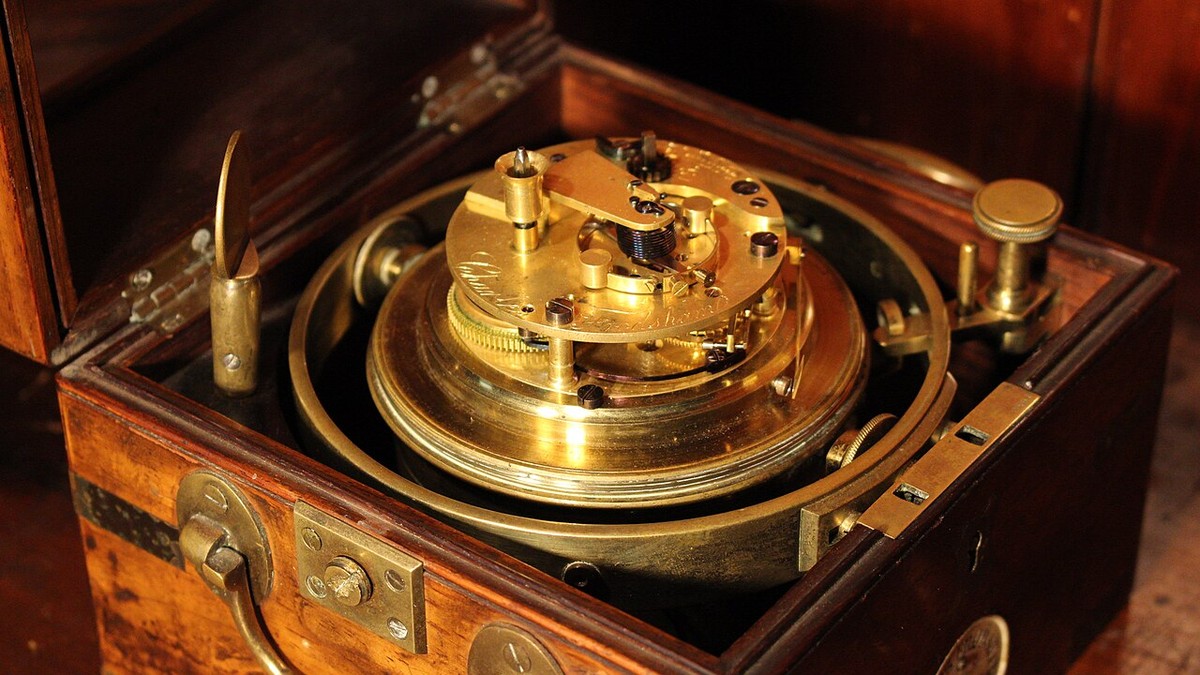
Harrison followed H1 with H2 (1741) and the complex H3 (1757), which introduced anti-friction caged ball bearings—an engineering mechanism decades ahead of the Industrial Revolution. Yet while H1, H2, and H3 proved that mechanical clocks could maintain time at sea, they were bulky, heavy, and sensitive to sudden violent wave impacts.
3. H4: The Masterpiece Sea Watch and the Trial to Jamaica (1761)
In 1753, while commissioning a pocket watch for his personal use from London watchmaker John Jefferys, Harrison experienced an epiphany: high-frequency, rapidly oscillating balance wheels were far more resistant to external disturbance than large, slow balance beams. Abandoning the massive clock architecture of H1–H3, Harrison devoted six years to constructing H4, completed in 1759.
Disguised within an elegant silver pocket-watch case 5.2 inches (13 cm) in diameter and weighing barely 3.2 pounds, H4 was the most sophisticated mechanical instrument on Earth. Operating at a rapid 5 beats per second (18,000 vibrations per hour), H4 incorporated diamond pallet stones on its modified verge escapement, a bimetallic compensation curb, and a revolutionary ‘remontoire’—an auxiliary spring rewound every 7.5 seconds by the mainspring to deliver completely constant driving force to the escapement, regardless of how wound down the mainspring was.
The Historic Caribbean Trials
In November 1761, the Board of Longitude subjected H4 to official sea trials aboard HMS Deptford, sailing from Portsmouth to Port Royal, Jamaica. The watch was placed in the care of Harrison’s son, William Harrison. When the ship reached the island of Madeira, the ship’s official navigators calculated their position through dead reckoning, while William Harrison, consulting H4, insisted they were nearly 90 miles further west than their charts indicated. Three hours later, Madeira appeared on the exact bearing predicted by H4.
Upon arriving in Jamaica in January 1762 after an 81-day ocean crossing, H4 was checked against local solar observations. The watch had lost a mere 5.1 seconds of time, corresponding to an error of 1.25 minutes of longitude—barely one nautical mile! H4 had not merely met the requirements of the 1714 Longitude Act; it had exceeded them by a factor of thirty.
⚓ Archival Quotation: King George III’s Intervention
Despite H4’s flawless performance, the academic-dominated Board of Longitude refused to award Harrison the £20,000 prize, demanding additional trials and withholding funds. An aging Harrison appealed directly to King George III in 1772. After testing Harrison’s H5 watch at his private observatory in Kew, the King famously declared: ‘By God, Harrison, I will see you righted!’—prompting Parliament to grant Harrison his full statutory reward in 1773.
4. Mass Production: Kendall, Arnold, and Earnshaw
While H4 proved that mechanical longitude was possible, the watch was an irreplaceable artisanal triumph that cost thousands of pounds to manufacture. For chronometers to transform global maritime commerce and naval strategy, the design had to be simplified, standardized, and mass-produced.
Larcum Kendall was commissioned by the Board of Longitude to construct an exact replica of H4. The resulting watch, K1 (completed in 1769), accompanied Captain James Cook on his monumental second voyage of exploration aboard HMS Resolution (1772–1775). Cook referred to K1 as his ‘never-failing guide’, charting New Zealand, Antarctica, and the Pacific islands with pinpoint cartographic precision.
The Spring Detent Escapement of Thomas Earnshaw
The transition to practical, commercially viable marine chronometers was accomplished in the 1780s by English horologist Thomas Earnshaw and his rival John Arnold. Earnshaw patented the spring detent escapement and the modern cut bimetallic temperature-compensated balance wheel. Earnshaw’s design eliminated Harrison’s fragile remontoire, allowing the balance wheel to swing completely free of friction for the majority of its cycle.
Earnshaw’s standardized chronometers could be manufactured for 40 to 50 guineas, enabling merchant vessels, East Indiamen, and Royal Navy warships to carry two or three marine chronometers on every long-distance voyage. By comparing three chronometers against one another (a practice known as ‘the rule of three’), navigators could immediately detect if one instrument had altered its rate, eliminating maritime navigation errors.
5. The Legacy of Mechanical Timekeeping in Global History
The conquest of longitude via marine chronometers fundamentally reshaped the course of modern world history. It transformed the oceans from terrifying voids into structured global trade highways. Navigators no longer needed to engage in the dangerous practice of ‘running down the latitude’ (sailing north or south to a destination’s known latitude and then sailing blindly east or west along that parallel, exposing ships to privateers and contrary winds).
Direct great-circle navigation drastically reduced transit times between Europe, the Americas, India, and the Far East, accelerating global trade in tea, spices, textiles, and manufactured goods. Furthermore, British hydrographers armed with marine chronometers mapped the coastlines, reefs, and harbors of the globe, laying the maritime infrastructural foundation for nineteenth-century globalization.
Today, John Harrison’s original timekeepers—H1, H2, H3, and H4—are conserved in fully functioning order at the Royal Observatory in Greenwich, London. They stand as enduring testaments to human perseverance, mechanical genius, and the transformative power of empirical science in conquering the vast expanses of the global ocean.
6. Mathematical Analysis of Horological Drift vs. Navigational Error
To grasp the astonishing mechanical achievement of John Harrison’s H4 chronometer during its Caribbean trials, one must examine the mathematical relationship between timekeeping drift and terrestrial distance. At the Earth’s equator, where circumference reaches 24,901 miles, one degree of longitude equals 60 nautical miles (69.1 statute miles). As an observer moves toward the poles, the physical distance of one degree of longitude compresses in direct proportion to the cosine of the latitude:
Distance of 1° Longitude (Nautical Miles) = 60 × cos(Latitude φ)
At the latitude of Jamaica (approximately 18° North), one second of clock error represents an east-west positional error of barely 1,440 feet (less than a quarter of a nautical mile). When H4 lost just 5.1 seconds over an 81-day ocean voyage across the Atlantic—subjected to continuous wave rolling, damp salt spray, and tropical temperature swings—Harrison’s watch maintained an accuracy of 99.999% over nearly two million beats of its balance wheel, a triumph of empirical micro-mechanics unprecedented in human technology.
| Clock Time Drift | Equatorial Distance Error | Mid-Atlantic Distance Error (30° N) | North Atlantic Error (50° N) | Navigational Implication |
|---|---|---|---|---|
| 1 Second per day | 0.25 Nautical Miles / day | 0.21 Nautical Miles / day | 0.16 Nautical Miles / day | Acceptable modern marine chronometer tolerance |
| 1 Minute over voyage | 15.0 Nautical Miles | 13.0 Nautical Miles | 9.6 Nautical Miles | Within statutory 1714 Longitude Act threshold |
| 5 Minutes drift | 75.0 Nautical Miles | 65.0 Nautical Miles | 48.2 Nautical Miles | Lethal hazard; leads to coastline grounding |
| 15 Minutes drift | 225.0 Nautical Miles | 194.8 Nautical Miles | 144.6 Nautical Miles | Equivalent to complete dead-reckoning failure |