⚓ Monograph Overview: The Hydrodynamic and Aerodynamic Dual Revolution
Between 1100 and 1500, European maritime technology underwent two interconnected revolutions that transformed the ocean-going ship from a seasonal coastal coaster into a global instrument of discovery. The replacement of fragile steering oars with the centerline pintle-and-gudgeon sternpost rudder provided unprecedented hydrodynamic control, while the fusion of northern square sails and Arab lateen sails created the full-rigged ship capable of sailing against the wind.
The physical capability of a sailing vessel is governed by a delicate, continuous equilibrium between two fluid mediums operating simultaneously: the aerodynamic airflow passing over its canvas sails above the waterline, and the hydrodynamic water flow passing around its submerged hull and steering foil beneath the surface. For thousands of years, ancient and early medieval mariners were trapped in an aerodynamic and hydrodynamic straitjacket. Their ships relied upon clumsy, lateral side-steering oars that could easily be torn away in heavy seas, and were powered by single, low-aspect square sails that functioned effectively only when sailing directly downwind (before the wind).
To venture beyond regional coastal trade and navigate the vast, unpredictable planetary wind bands of the global ocean—the Northeast Trade Winds, the Roaring Forties, and the Doldrums—shipwrights had to solve two fundamental mechanical challenges. Beneath the waterline, they needed a powerful, unbreakable, centerline steering foil that could maintain directional stability in towering seas. Above the waterline, they required an articulated, multi-sail aerodynamic rig that could generate lift to windward, allowing a ship to ‘tack’ and make progress against contrary headwinds.
The convergence of the centerline sternpost rudder (utilizing iron pintle-and-gudgeon hinges) with the full-rigged three-masted sail plan (synthesizing northern square drive with Mediterranean and Arab triangular lateen sails) between 1200 and 1450 represents the true technological launchpad of modern world history.
1. The Steering Evolution: From Side-Oars (Steorbord) to the Sternpost
In classical antiquity and early medieval Northern Europe, ships were steered not from the centerline of the stern, but using one or two large, heavy steering oars (known as quarter rudders or side rudders) mounted over the side of the hull near the right stern quarter. This nautical arrangement gave rise to the English word starboard (derived from the Old Norse stýri meaning ‘rudder’ and borð meaning ‘the side of the ship’).
While side rudders were effective on light, shallow-draft vessels like Viking longships and Mediterranean galleys, they suffered from catastrophic mechanical vulnerabilities on larger ocean-going craft:
- Mechanical Asymmetry: When a ship heeled under sail, the leeward steering oar was forced deep underwater, creating severe asymmetrical drag, while the windward oar lifted completely out of the water, leaving the pilot unable to steer.
- Structural Fragility: Attached to the hull only by leather straps or flexible willow grommets, quarter rudders were frequently snapped or torn away when struck by heavy Atlantic storm swells or when docking alongside wharves.
- Manual Torque Limits: As ship displacements exceeded 100 tons, the hydrodynamic torque required to turn the heavy blade through the water surpassed the physical muscle capacity of two or three helmsmen straining against the steering tiller.
The Pintle-and-Gudgeon Centerline Rudder
The definitive breakthrough occurred in the Baltic and North Sea during the late twelfth century, first appearing on town seals of Hanseatic ports like Elbing (1242) and Ipswich (1200): the pintle-and-gudgeon sternpost rudder. Shipwrights flattened the curving double-ended stern of their ships, creating a vertical, straight sternpost scarphed directly onto the aft end of the heavy keel.
The rudder blade—a massive, solid oak vertical foil—was hung directly onto the centerline sternpost using heavy wrought-iron interlocking hinges. The rudder carried downward-pointing vertical iron pins known as pintles, which dropped securely into matching circular iron ring-sockets (known as gudgeons) bolted through the ship’s sternpost. Held firmly in place by gravity and hydrodynamic pressure, the centerline rudder could rotate freely through a wide arc of steering angles without the slightest danger of being torn free by wave impact.
| Steering Technology | Mounting Location & Geometry | Mechanical Fasteners | Hydrodynamic Efficiency | Maximum Ship Burden Handled |
|---|---|---|---|---|
| Classical Quarter Rudder | Right aft side (Steorbord quarter) | Leather straps, boss pivots, hemp strops | Poor; asymmetrical drag; lifts when heeling | Rarely exceeded 100–150 tons displacement |
| Sternpost Rudder (Pintle/Gudgeon) | True centerline aft vertical sternpost | Heavy wrought-iron pintle pins & gudgeon eyes | High; symmetrical hydrodynamic lift & turning | Limitless scaling (exceeded 3,000+ tons) |
| Whipstaff Steering Lever | Between lower tiller deck and upper quarterdeck | Vertical pivot pin with sliding iron ring | Multiplies mechanical leverage; operator sheltered | Standardized on 16th/17th Century galleons |
| Nautical Steering Wheel (1705+) | Quarterdeck helm station with barrel drum | Hemp/wire steering ropes through pulley blocks | Enormous mechanical advantage; single-helmsman control | Universal on multi-deck ships of the line |
2. The Mechanical Linkage Revolution: From Whipstaff to Helm Wheel
The adoption of the centerline sternpost rudder created a new civil engineering challenge inside the ship: how to control the heavy rudder from the upper deck. The top of the rudder blade carried a massive horizontal oak beam known as the tiller, which projected forward into the interior of the ship beneath the lower deck.
In smaller vessels, the helmsman steered by pushing the tiller directly with his hands. But as warships grew into towering three-story wooden fortresses, the tiller was situated deep inside the dark, enclosed gunroom, while the ship’s captain and officers commanded the vessel from the high quarterdeck sixty feet away.
The Whipstaff (16th and 17th Centuries)
During the sixteenth century, shipwrights invented the whipstaff (or kolderstock). The whipstaff was a long, slender vertical wooden lever that passed through a pivoting ring (the rowle) cut into the deck floor. The lower end of the whipstaff was slotted over the forward tip of the horizontal tiller in the hold, while the upper end was held by the helmsman standing in a tiny enclosed cuddy box on the quarterdeck.
By levering the whipstaff left or right, the helmsman gained mechanical advantage, swinging the heavy rudder through five to ten degrees of helm. However, the whipstaff was physically limited: it could not rotate the rudder more than ten or twelve degrees to either side, and in violent gales, the sudden slap of a wave against the rudder could jerk the whipstaff violently across the cabin, breaking the helmsman’s ribs.
The Nautical Wheel (c. 1705)
The definitive triumph occurred around 1705 with the invention of the nautical steering wheel. The wheel consisted of an eight- or ten-spoke circular wooden wheel connected to a horizontal rotating wooden drum (barrel). Heavy hemp or brass steering cables were wound around this drum, led through a series of low-friction pulley blocks down through the decks, and fastened to the end of the tiller.
The wheel provided immense mechanical leverage. A single helmsman could rotate the wheel through multiple complete revolutions, swinging the massive oak rudder through a full 35 degrees of angle against the most violent Atlantic currents with effortless precision.
3. The Aerodynamic Rigging Revolution: Lateen Sails vs. Square Sails
While the sternpost rudder transformed underwater hydrodynamics, an equally profound revolution was unfolding in the air. In early medieval navigation, European mariners were geographically divided by their rigging:
- The Northern Square Rig: Traditional in the North Sea and Baltic, the square sail consisted of a broad rectangular canvas hung horizontally from a central yard. The square rig was an outstanding downwind sail; it caught the prevailing wind like a parachute, generating massive aerodynamic pushing force (drag thrust). However, it could not sail toward the wind; if a ship attempted to sail closer than 70 or 80 degrees off the wind, the canvas fluttered, backfilled, and stalled.
- The Mediterranean/Arab Lateen Rig: Developed in the Indian Ocean and introduced into the Mediterranean by Arab navigators, the lateen sail was a tall, triangular canvas hung along a long, angled yard (the antenna) suspended obliquely from a short mast. The lateen sail was an early airfoil; it generated aerodynamic lift (similar to an airplane wing), allowing vessels like Mediterranean dhows and galleys to point high into the wind and ‘tack’ forward against contrary breezes.
⚓ Aerodynamic Principle: Lift vs. Drag Propulsion
Square sails operate primarily on aerodynamic drag: the wind blows into the concave belly of the sail, pushing the ship forward along the wind vector. Lateen and fore-and-aft sails operate on aerodynamic lift: wind flows over the curved outer surface of the canvas faster than the inner surface, creating a localized pressure drop (Bernoulli’s principle) that pulls the ship forward toward the wind.
4. The Synthesis: The Birth of the Full-Rigged Three-Masted Ship
The pivotal moment that launched the global Age of Discovery occurred in fifteenth-century Portugal and Spain under the naval direction of Prince Henry the Navigator. Master shipwrights combined both traditions into a single vessel: the caravel (caravela) and the carrack (nau).
Initially, Portuguese explorers sailed in the caravela latina—a light, nimble craft rigged exclusively with triangular lateen sails. These vessels were masters of windward sailing, enabling navigators to explore the western coast of Africa and execute the legendary volta do mar (sailing far out into the open Atlantic to catch favorable trade winds back to Europe). However, all-lateen rigs had a severe defect: in heavy ocean gales, their giant angled lateen yards were dangerous to handle, requiring dozens of men on deck to heave the heavy spar around the mast every time the ship tacked.
The Standardized Three-Masted Rig
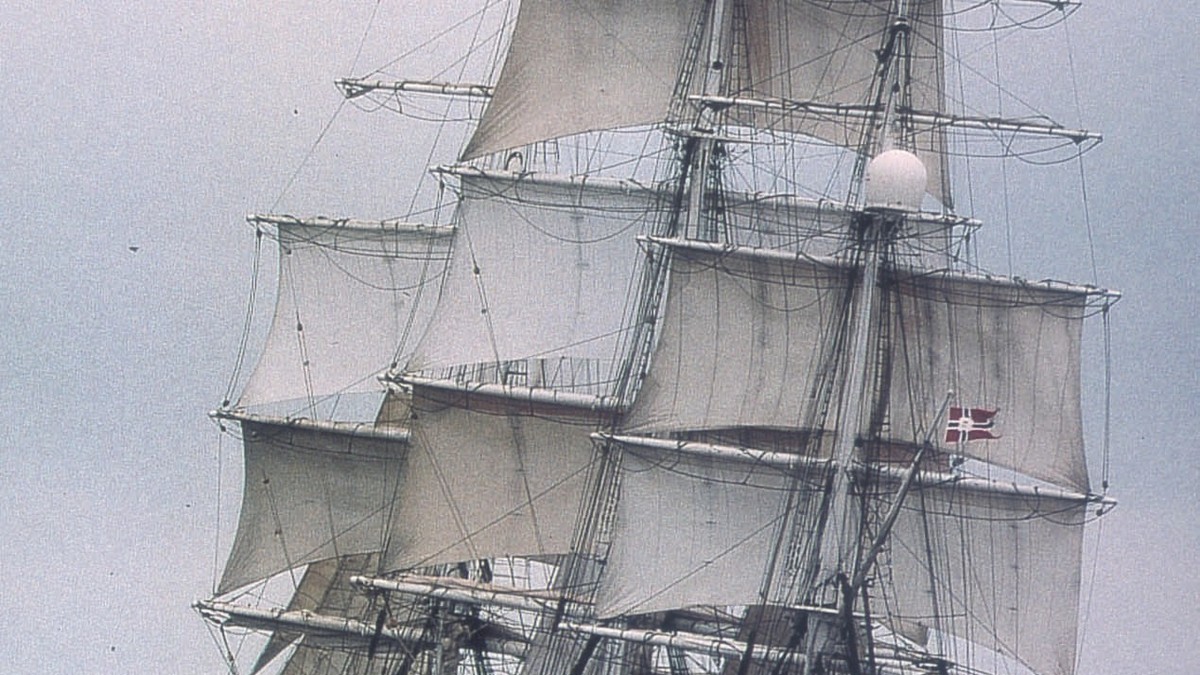
The definitive synthesis was the full-rigged ship (caravela redonda and carrack), which combined both sail geometries into a specialized multi-tier aerodynamic battery:
- Foremast and Mainmast (Square-Rigged): Carried powerful horizontal square sails (courses, topsails, and topgallants) to provide raw driving power when running before the trade winds.
- Mizzenmast (Lateen-Rigged): Carried a triangular lateen sail on the stern castle. Because the lateen sail acted behind the ship’s center of lateral resistance, trimming the lateen yard acted like an aerodynamic rudder, allowing the ship to easily swing her bow through the wind when tacking.
- Bowsprit and Spritsail: A forward-projecting spar carrying a small square spritsail beneath it, counterbalancing the mizzen lateen and providing precise aerodynamic trim to keep the ship on a straight course.
5. The Legacy of the Full-Rigged Ship in Modern Maritime History
The full-rigged three-masted ship was the most complex and powerful thermodynamic machine developed by humanity prior to the steam engine. Over the subsequent four centuries, naval architects refined this basic three-masted architecture, adding jib sails, stay sails, and royal sails, culminating in the breathtaking Victorian clipper ships of the 1850s—such as the Cutty Sark and Thermopylae—which could race across 3,000 miles of ocean under 30,000 square feet of canvas at speeds exceeding 17 knots.
The dual revolution of the sternpost rudder and articulated multi-masted rigging transformed the ocean from an impassable void into an interconnected global highway. It gave humanity the technological mastery to steer through hurricane seas, claw off lethal lee shores, and circumnavigate planet Earth on the power of the wind alone.
6. The Aerodynamics of Sail Trimming: Polar Diagrams and Tacking Angles
The operational triumph of the full-rigged ship was its ability to claw its way windward across ocean basins using the technique of tacking (beating to windward). When sailing close-hauled against a headwind, the ship cannot sail directly into the wind; it sails at an angle across the wind, zig-zagging toward its destination in alternating port and starboard tacks.
In classical square-rigged ships of the line, the yards could be braced around to an angle of barely 40 to 45 degrees off the ship’s centerline. Consequently, a square-rigger could point no closer than six points (67.5 degrees) off the true wind direction. Including leeway (the lateral drift of the hull through the water caused by wind pressure), the ship’s effective course over ground was barely 75 degrees off the wind. By combining fore-and-aft lateen sails, staysails, and jibs with the main square battery, Victorian clipper ships reduced this tacking angle to barely 50 degrees, doubling their windward transit velocity across global trade routes.
| Point of Sailing | Angle to True Wind | Primary Aerodynamic Mechanism | Active Sail Deployment | Sailing Efficiency |
|---|---|---|---|---|
| Running Before the Wind | 160° to 180° (Dead astern) | Pure aerodynamic drag thrust | All square courses, topsails, and studdingsails | Maximum drive; zero heel; rolling motion |
| Broad Reach | 120° to 150° (Off quarter) | Combined aerodynamic lift and drag | Full square battery and staysails | Fastest point of sailing for square-riggers |
| Beam Reach | 90° (Perpendicular to hull) | Aerodynamic lift across curved canvas | Yards braced to 45°; jibs and staysails flat | High speed; moderate heel angle |
| Close-Hauled (Tacking) | 55° to 67.5° (Beating windward) | Pure aerodynamic vortex lift | Yards braced sharp; bowlines hauled taut | Essential for clawing off dangerous lee shores |