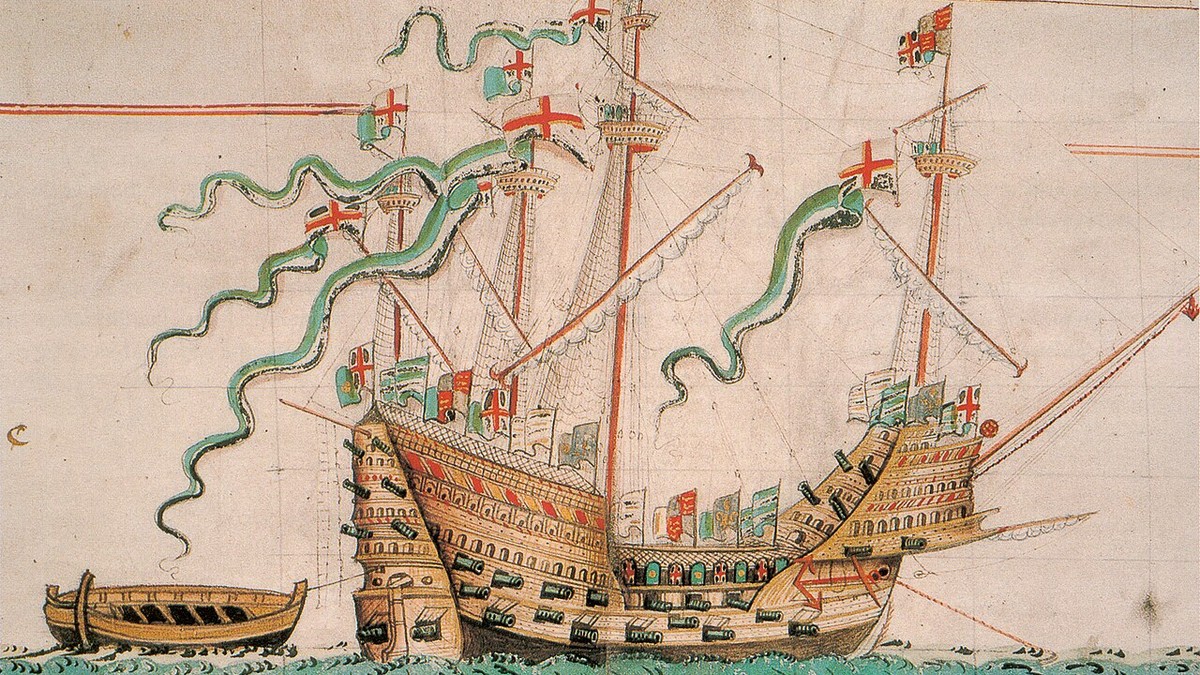
⚓ Monograph Overview: The Tudor Flagship Mary Rose
Commissioned under King Henry VIII in 1510, the Mary Rose represented a transitional pinnacle in European naval architecture. Serving as one of the earliest purpose-built English warships capable of firing broadside ordnance through watertight lidded gunports, her sudden sinking on July 19, 1545, during the Battle of the Solent preserved a pristine cross-section of Tudor military technology. Her historic raising in 1982 remains the definitive triumph of maritime archaeology.
The dawn of the sixteenth century brought a profound geopolitical transformation across Western Europe, compelling oceanic monarchies to reconsider the tactical purpose and structural capacity of sea-going craft. In the British Isles, King Henry VIII embarked upon an unprecedented expansion of the royal fleet, moving away from the medieval practice of requisitioning armed merchant vessels and establishing a permanent, purpose-built naval force known as the Navy Royal. At the forefront of this architectural renaissance was the Mary Rose, a four-masted warship launched at Portsmouth in 1511. Measuring approximately 500 tons upon her initial completion, the vessel underwent a massive structural refit in 1536 that increased her displacement to over 700 tons, radically transforming her defensive lines, sail plan, and artillery decks.
For more than three decades, the Mary Rose served as the vice-flagship of the English navy, participating in repeated naval campaigns against the Kingdom of France and the Kingdom of Scotland. Her career culminated during the dramatic engagements of the Italian War of 1542–1546. On July 19, 1545, while leading the English vanguard against a massive French invasion fleet commanded by Claude d’Annebault in the treacherous waters of the Solent between Portsmouth and the Isle of Wight, the great warship heeled abruptly in a sudden gust of wind, took on water through her open lower gunports, and vanished beneath the waves within minutes. Trapped beneath an anti-boarding net strung tightly across her main deck, approximately 500 sailors, soldiers, and archers perished in full view of King Henry VIII on Southsea Castle.
However, the tragic loss of the Mary Rose became humanity’s greatest archaeological inheritance. Embedded deep within the anaerobic silt and marine mud of the Solent seabed for 437 years, the starboard half of her timber hull, alongside more than 26,000 preserved artefacts, remained shielded from wood-boring shipworms (Teredo navalis). Her rediscovery by Alexander McKee and marine archaeologist Margaret Rule, followed by her dramatic raising by the Mary Rose Trust on October 11, 1982, revolutionized contemporary understanding of Tudor naval architecture, bronze cast ordnance, longbow ballistics, shipboard medicine, and sixteenth-century seafaring life.
1. Tudor Naval Architecture and Hull Framing Technology
The construction of the Mary Rose occurred at the precise historical juncture where Northern European shipbuilding transitioned from medieval clinker construction to Mediterranean-inspired carvel framing. In traditional clinker building, overlapping hull planks provided the primary structural integrity, severely restricting the overall tonnage and load-bearing capacity of the hull. Carvel construction, by contrast, relied upon a massive internal skeleton of oak framing ribs onto which smooth, edge-to-edge planking was fastened using treenails (heart-of-oak dowels) and iron bolts.
The initial 1510–1511 build was executed under the direction of master shipwright Robert Brigandine, using seasoned English oak (Quercus robur) felled primarily in the royal forests of Hampshire and the Weald of Kent. Dendrochronological analysis of the hull’s surviving structural members reveals that mature oak trees over 150 to 200 years old were selected for the heavy keelson, floor timbers, and massive futtocks. The original carvel hull was strengthened with heavy external rubbing strakes and transverse cross-beams designed to absorb the immense hydrostatic pressures of heavy seas and the internal recoil of deck-mounted artillery.
The 1536 Rebuilding and Tonnage Expansion
In 1536, anticipating renewed naval conflict with France and Spain, Henry VIII mandated a comprehensive restructuring of his premier warships. The Mary Rose was taken into the newly engineered dry dock at Portsmouth, where shipwrights significantly altered her internal deck geometry. The refit introduced an additional continuous gun deck, deepened the draft, and increased her nominal burden from 500 to 700 tons. This enlargement allowed the inclusion of heavy wrought-iron breech-loading guns alongside cast-bronze muzzle-loaders, requiring substantial reinforcement of the deck carlings and knees.
Crucially, the 1536 modifications lowered the sill height of the lowest tier of gunports relative to the waterline. Under normal trim, the lowest gunports stood barely 16 to 18 inches (40 to 45 centimeters) above the water surface. To prevent flooding while underway, these gunports were fitted with heavy oak lids lined with oiled leather seals and held tightly shut by internal ropes and iron dog-bolts. However, during active tactical combat, these ports had to be unlatched and swung upward, rendering the ship exceptionally vulnerable to sudden shifts in ballast, wind heeling, or rapid helm maneuvers.
| Structural Metric | 1511 Initial Construction | 1536 Post-Rebuild | Archaeological Evidence |
|---|---|---|---|
| Nominal Displacement / Burden | 500–600 Tons | 700–800 Tons | Excavated starboard displacement modeling |
| Hull Construction Method | Carvel plank on heavy oak frame | Reinforced carvel with doubled knees | 53m preserved keel-to-gunwale section |
| Lower Gunport Water Clearance | Approx. 28 inches (71 cm) | Approx. 16 inches (40 cm) | Measured lower tier sill datum |
| Complement (Crew & Troops) | 400 men (250 sailors, 120 soldiers) | 500 men (including 185 archers/marines) | Exoskeletal skeletal remains of >179 individuals |
| Primary Timber Species | English White Oak (Quercus robur) | Seasoned Oak & Elm keel | Dendrochronological ring-count 1380–1535 |
2. The Artillery Revolution: Mixed Ordnance and Watertight Gunports
Prior to the introduction of dedicated broadside gunports, shipboard artillery was largely confined to light, antipersonnel swivel guns mounted along the upper gunwales, forecastles, and aft castles. These weapons were intended to sweep opposing decks prior to grappling and boarding. The Mary Rose, however, participated directly in the birth of artillery-based naval combat, where heavy kinetic projectiles were directed at the enemy’s structural waterline to induce catastrophic structural failure and sinking.
To accommodate this radical doctrine, the ship was outfitted with two distinct technological philosophies of artillery: massive, cast-bronze muzzle-loading culverins and cannons, and composite wrought-iron breech-loading guns. The cast-bronze guns, manufactured by master founders such as Humphrey Walker and the Arcanus family of Italy, represented the cutting edge of sixteenth-century metallurgy. Pouring molten bronze into clay molds around iron cores produced seamless barrels capable of withstanding immense chamber pressures generated by corned gunpowder, allowing the propulsion of cast-iron shot over ranges exceeding 1,500 yards.
Wrought-Iron Breech-Loaders: Construction and Function
Conversely, the wrought-iron guns—such as portpieces, fowlers, and slings—were assembled using an ancient cooperage technique. Wrought-iron strakes were forged longitudinal along a cylindrical mandrel, and red-hot iron hoops were subsequently hammered over them. As the outer hoops cooled, they contracted forcefully around the inner longitudinal bars, creating an airtight, compressive barrel. These weapons utilized separate removable powder chambers (mugs) that were wedged into the breech mechanism with iron keys.
While the wrought-iron breech-loaders lacked the chamber pressure and muzzle velocity necessary to crack heavy hull timbers, they offered an extraordinary rate of fire against enemy personnel. Crews could pre-load dozens of iron chambers with black powder and insert stone round-shot, iron dice, or lead canisters, discharging multiple volleys into opposing boarding parties in rapid succession before swapping chambers.
| Artillery Classification | Material & Manufacture | Breech / Muzzle | Projectile Type & Weight | Tactical Function |
|---|---|---|---|---|
| Culverin / Semi-Culverin | Cast Bronze (Arcanus/Walker) | Muzzle-loading | Cast Iron Shot (9 to 18 lbs) | Long-range hull perforation at waterline |
| Cannon / Demi-Cannon | Cast Bronze | Muzzle-loading | Cast Iron / Lead Shot (32 to 42 lbs) | Heavy kinetic battery; main deck demolition |
| Portpiece | Wrought-Iron Hooped Barrels | Breech-loading (Detachable chamber) | Granite Stone Shot (6 to 12 lbs) | Medium-range anti-rigging and broadside defense |
| Fowler | Wrought-Iron with hoops | Breech-loading | Stone balls & lead scatter-shot | Close-quarters anti-boarding deck clearance |
| Hailshot Piece | Cast Iron / Wrought Iron | Breech-loading | Square iron dice & scrap | Upper deck swept antipersonnel barrage |
3. The Sinking at the Battle of the Solent (July 19, 1545)
The circumstances surrounding the sudden foundering of the Mary Rose have generated nearly five centuries of scholarly debate, technical investigation, and maritime hydrodynamic modeling. Contemporary sixteenth-century eyewitness accounts present conflicting narratives regarding the disaster, with French naval chroniclers claiming that French galley gunfire punctured the vessel below the waterline, while English witnesses, including Sir Gawen Carew (brother of the ship’s vice-admiral Sir George Carew), attributed the loss to catastrophic mishandling and indiscipline among the crew.
Detailed physical examination of the recovered hull timbers by modern naval architects, combined with digital computational fluid dynamics (CFD) reconstructions, has illuminated the precise sequence of mechanical failures. Having engaged the advancing French galleys with her heavy starboard broadside, the Mary Rose executed a rapid tacking maneuver to bring her unexpended port battery into firing position. As the ship swung through the wind, a sudden southern squall struck her immense towering upper works—the four-tier aft castle and high forecastle.
Hydrodynamic Instability and the Anti-Boarding Netting Trap
With her helm put hard over, the centrifugal turning moment compounded the lateral wind-heeling force, forcing the ship’s starboard side deep into the water. Crucially, the starboard gunners had failed to secure and dog-down the lower tier gunports after discharging their pieces, likely due to the haste of combat and the suffocating smoke filling the gun decks. As the lower sill of the third gunport dipped beneath the surface of the Solent, sea water poured in at an accelerating rate of thousands of gallons per second.
The sudden influx of dynamic free-surface water instantly overwhelmed the ship’s positive righting arm (GZ). Unsecured iron shot, heavy ballast stones in the bilge, and spare artillery chambers broke free, crashing against the lower interior bulkheads and locking the ship in an unrecoverable heel. Within less than three minutes, the Mary Rose rolled onto her side and sank into the channel. Compounding the human tragedy was the heavy hemp anti-boarding netting rigged tightly over the main deck waist to prevent French marines from leaping aboard; when the ship went down, this netting functioned as an inescapable cage, trapping hundreds of heavily armored men beneath the rushing sea.
⚓ Archaeological Insight: The Human Remains of the Tudor Crew
Osteological analysis of the 179 recovered individual skeletons revealed extraordinary physical biographies. The ship’s archers exhibited marked asymmetry in their shoulder blades, left clavicles, and right arm joints—a physiological condition termed ‘os acromiale’ caused by the immense muscular strain of drawing English longbows with pull-weights between 100 and 150 pounds from early adolescence.
4. The Archaeological Odyssey: Discovery, Excavation, and Raising
For more than four centuries, the wreck lay largely undisturbed beneath the shifting sands of the Solent, approximately 12 meters beneath low water. Although pioneer salvage divers John and Charles Deane utilized their newly patented open-helmet diving apparatus to recover several bronze and iron guns from the site in 1836, the wreck soon silted over and was lost to living memory. It was not until 1965 that amateur historian Alexander McKee, under the auspices of Project Solent Ships, initiated a methodical acoustic survey of the seabed using pioneering dual-frequency side-scan sonar.
Sub-bottom acoustic profiling conducted in 1967 revealed an anomalous subsurface feature buried beneath deep sediments. In 1971, winter storms stripped away the protective mud overburden, exposing the tops of several Tudor oak frames. Over the subsequent decade, maritime archaeologist Margaret Rule led one of the most ambitious underwater scientific excavations in human history. Operating over 28,000 dives and logging more than 22,000 hours of seabed excavation, volunteer and professional divers carefully mapped, photographed, and recovered every artifact utilizing water dredges, airlifts, and stereophotogrammetry.
The Engineering Triumph of the 1982 Lifting Frame
The recovery of the surviving 280-ton starboard hull section posed unprecedented mechanical and structural challenges. Waterlogged archaeological oak loses its internal cellulose structure, leaving it soft, spongy, and prone to catastrophic collapse under atmospheric gravity. Engineers designed an ingenious three-point underwater lifting cradle known as the ‘Toghill Frame’, accompanied by an external cushioned recovery cradle lined with water-filled air bags.
Divers drilled hundreds of tiny holes through the hull timbers, inserting steel pins connected to load-spreading spreader bars and suspension wires. On October 11, 1982, the massive floating crane barge Tog Mor carefully elevated the wreck from the sea floor into the water-filled cradle. Suspended beneath the surface, the cradle was carried into Portsmouth Harbour before being brought into Dry Dock No. 3—the very dock where the ship had been refitted in the sixteenth century—under the watchful gaze of millions of international television viewers.
5. Conservation Science and the Modern Mary Rose Museum
Once settled into dry dock, the immediate danger to the Mary Rose was cellular shrinkage and structural collapse. If archaeological timber dried naturally, capillary tension within the evaporated water would crush the fragile waterlogged cell walls, reducing centuries-old oak to dust. Conservation scientists implemented an exhaustive, three-decade-long chemical stabilization regimen.
For the first twelve years (1982–1994), the hull was continuously sprayed 24 hours a day with chilled water saturated with fungicides to prevent biological decay. In 1994, the water spray was replaced with a solution of Polyethylene Glycol (PEG), a water-soluble synthetic wax. Over an intensive sixteen-year period, the molecular weight of the PEG spray was gradually increased from low-molecular PEG 200 (which penetrated deep into the microscopic cellular matrix) to high-molecular PEG 2000, which hardened within the outer timber layers, providing mechanical rigidity.
Controlled Dehumidification and Environmental Encapsulation
In April 2013, having absorbed thousands of liters of PEG, the spray jets were turned off, and the Mary Rose entered her final preservation phase: controlled air drying inside a custom-engineered, hermetically sealed building envelope. Over 100 kilometers of internal ducting regulated the relative humidity at exactly 54% and the temperature at 18 degrees Celsius, slowly extracting over 100 tons of remaining moisture without cracking the oak strakes.
Today, housed within the award-winning £35 million Mary Rose Museum in Portsmouth Historic Dockyard, the ship stands completely visible through floor-to-ceiling panoramic glass viewing galleries. Flanked by thousands of conserved Tudor items—including navigational pocket sundials, bone dice, leather jerkins, pewter flagons, surgical tools, and intact English yew longbows—the Mary Rose stands as an immortal monument to Tudor engineering, naval combat, and the supreme triumphs of modern maritime science.