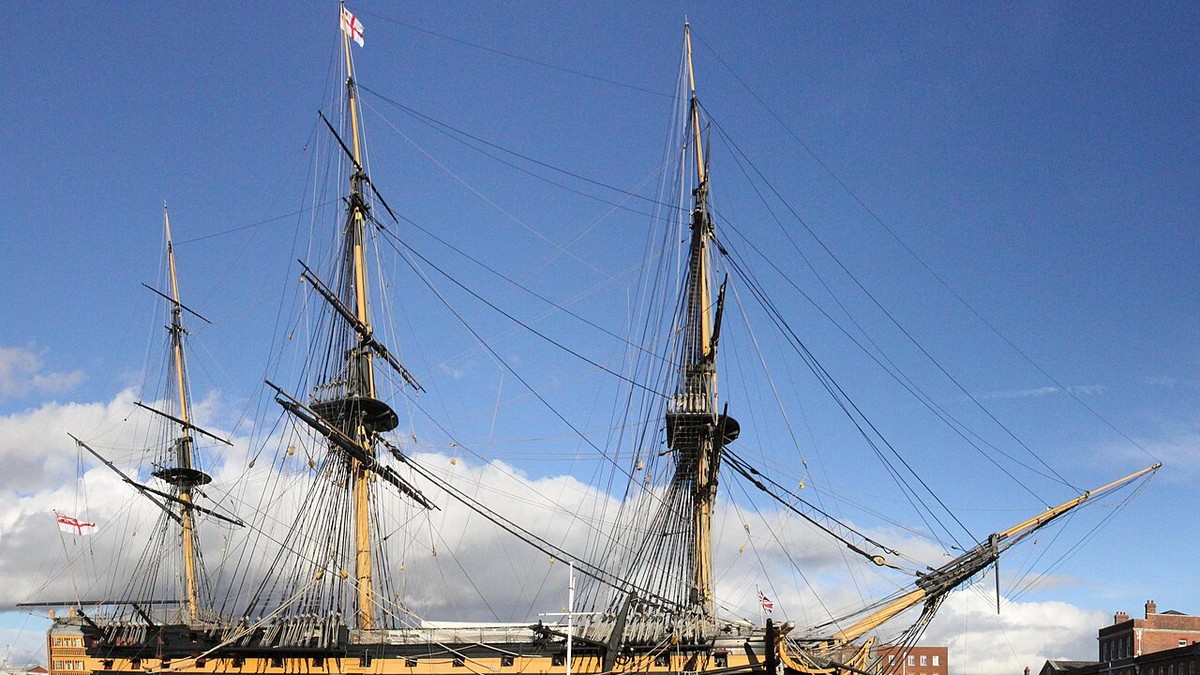
⚓ Monograph Overview: The Definitive First-Rate Flagship
Launched in 1765, HMS Victory represents the highest operational zenith of the wooden sailing warship. Serving as the flagship of Vice-Admiral Lord Horatio Nelson at the Battle of Trafalgar on October 21, 1805, her triple-decked gun battery, live-oak hull architecture, and revolutionary tactical deployment shattered the combined Franco-Spanish fleet, cementing British naval supremacy for more than a century.
The Age of Sail reached its supreme tactical and architectural maturity during the Napoleonic Wars (1803–1815), an era defined by titanic naval clashes across the Atlantic, the Mediterranean, and the Caribbean. Dominating this geopolitical epoch were the great ‘first-rate’ ships of the line—the wooden dreadnoughts of their day—designed to carry 100 or more heavy smoothbore guns distributed across three enclosed gun decks. Among these extraordinary machines of war, none attained greater renown than HMS Victory, a 104-gun first-rate vessel designed by Master Surveyor of the Royal Navy Sir Thomas Slade and launched from Chatham Dockyard in 1765.
While the Royal Navy possessed dozens of line-of-battle ships, HMS Victory stood apart for her exceptional sailing qualities, structural rigidity, and speed. Often ships of her immense displacement suffered from sluggish helm response, excessive heel under full canvas, and severe leeway. Slade’s hull design, however, incorporated subtle underwater curvature, sharp entry lines, and a perfectly balanced center of lateral resistance that made Victory an exceptionally responsive flagship. Over her forty years of active frontline service prior to Trafalgar, she flew the flags of legendary naval commanders including Augustus Keppel, Sir Charles Hardy, Richard Kempenfelt, Lord Howe, and Sir John Jervis at the Battle of Cape St. Vincent.
Her immortal destiny was sealed, however, on October 21, 1805, off Cape Trafalgar, Spain. Leading the weather column of the British fleet directly into the defensive broadside crescent of thirty-three Franco-Spanish ships of the line, Nelson utilized Victory’s immense oak hull to absorb devastating raking gunfire before puncturing the enemy center. The battle shattered Napoleon Bonaparte’s maritime ambitions, cost Nelson his life on Victory’s quarterdeck, and established the definitive doctrine of decisive naval battle for modern naval history.
1. First-Rate Naval Architecture: Slade’s Masterwork
Sir Thomas Slade designed HMS Victory according to the Admiralty’s 1745 Establishments and subsequent revisions, seeking to combine maximum artillery density with sea-keeping stability. Built at Chatham under Master Shipwright Edward Allen, the ship required approximately 6,000 mature trees, over 90% of which were prime English White Oak (Quercus robur). The felling of these timbers consumed an estimated 100 acres of ancient woodland, primarily in Sussex, Kent, and the New Forest.
The keel of the ship was laid down on July 23, 1759. Measuring 226 feet and 6 inches in overall length, with a gundeck length of 186 feet and a beam of 51 feet 10 inches, Victory displaced 3,500 tons at full battle trim with a draft of 25 feet. Her structural heart was her massive oak keel, constructed from seven enormous elm baulks scarphed and bolted together with copper and iron pins. Attached to this foundation was an intricately fitted system of double floor timbers and futtocks, creating an impenetrable timber wall whose thickness at the lower gundeck waterline exceeded two feet (60 centimeters) of solid cured oak.
The Copper Sheathing Revolution
One of the most consequential technological enhancements bestowed upon Victory during her major refit at Portsmouth in 1780 was the complete sheathing of her underwater hull in copper plating. Unprotected wooden hulls sailing in tropical and warm temperate waters suffered catastrophic degradation from the shipworm (Teredo navalis) and severe speed reduction caused by heavy barnacle and seaweed encrustation.
The Royal Navy’s adoption of rolled copper sheets, held against the outer elm planking with copper alloy nails over a layer of tarred paper and pitch, generated an electro-chemical biocide that prevented marine growth and wood infestation. This allowed Victory and her sister ships to remain at sea continuously for months without drydocking, giving British squadrons an overwhelming logistical advantage in sustained naval blockades against French and Spanish ports.
| Technical Metric | Specification | Engineering / Operational Detail |
|---|---|---|
| Gundeck Length | 186 feet (56.7 meters) | Accommodates 30 heavy 32-pounder guns |
| Maximum Beam | 51 feet 10 inches (15.8 m) | Engineered for maximum lateral stability in heavy seas |
| Displacement | 3,500 Tons at battle load | Carrying 850 crew, 1,000 tons ballast, 6 months provisions |
| Total Sail Area | Approx. 6,510 square yards (5,440 m²) | Spread across 3 towering masts, 37 distinct sails |
| Mainmast Height | 205 feet (62.5 meters) above waterline | Constructed from Douglas fir and Riga pine spars |
| Top Speed Under Canvas | 8 to 9 Knots | Exceptional speed and windward ability for a triple-decker |
2. Artillery Configuration and Three-Deck Firepower
At the Battle of Trafalgar, HMS Victory carried a standardized main armament of 104 muzzle-loading smoothbore guns cast from gray iron. These guns were arrayed across three continuous internal decks, plus open batteries mounted along the quarterdeck, forecastle, and poop deck. The distribution of this ordnance was calculated with mathematical precision to prevent top-heaviness and structural hogging (the drooping of the bow and stern relative to the midship section).
The lower gundeck, sitting barely five to six feet above the waterline, mounted the ship’s primary heavy battery: thirty 32-pounder cannons. Each 32-pounder gun weighed over 3.5 tons (56 cwt) without its oak carriage. Manned by an intensely drilled crew of twelve sailors and two powder monkeys, a single 32-pounder could discharge a 32-pound solid iron cannonball with a propellant charge of 10.5 pounds of black powder every 90 seconds. At point-blank combat ranges (under 100 yards), a 32-pound shot achieved a muzzle velocity of approximately 1,600 feet per second, penetrating up to 30 inches of solid oak timber.
The Middle and Upper Battery Tiers
Directly above the lower tier, the middle gundeck housed twenty-eight 24-pounder guns, offering an optimal balance between range, penetration, and reloading cycle. The upper gundeck mounted thirty 12-pounder guns, designed to strip enemy rigging, destroy deck equipment, and decimate opposing gun crews. Finally, the open forecastle and quarterdeck mounted an array of twelve 12-pounders alongside two massive 68-pounder carronades—short-barreled, lightweight heavy-smashers known colloquially as ‘the Smashers’.
| Deck Level | Artillery Complement | Weight per Gun Barrel | Shot Diameter & Weight | Effective Penetration Range |
|---|---|---|---|---|
| Lower Gundeck | 30 × 32-Pounder Cannons | 56 cwt (6,272 lbs / 2,845 kg) | 6.41 inches / 32 lbs solid iron | Point-blank to 1,200 yards (waterline hull demolition) |
| Middle Gundeck | 28 × 24-Pounder Cannons | 48 cwt (5,376 lbs / 2,438 kg) | 5.82 inches / 24 lbs solid iron | Point-blank to 1,500 yards (mid-tier counter-battery) |
| Upper Gundeck | 30 × 12-Pounder Long Guns | 34 cwt (3,808 lbs / 1,727 kg) | 4.62 inches / 12 lbs solid iron | Anti-rigging, mast cutting, and upper hull strike |
| Quarterdeck | 12 × 12-Pounder Short Guns | 29 cwt (3,248 lbs / 1,473 kg) | 4.62 inches / 12 lbs solid iron | Close-quarters broadside defense & command deck security |
| Forecastle | 2 × 12-pdrs + 2 × 68-pdr Carronades | Carronade: 36 cwt (4,032 lbs) | 8.05 inches / 68 lbs lead canister & round | Point-blank broadside raking across enemy stern galleries |
3. Tactical Doctrine: The Raking Fire at Trafalgar
Traditional eighteenth-century naval combat adhered to rigid ‘Fighting Instructions’, which mandated that opposing fleets form parallel lines of battle and exchange horizontal broadsides at moderate ranges. This orthodox tactic rarely produced decisive results, often allowing damaged enemy ships to disengage and escape into coastal waters. Vice-Admiral Lord Horatio Nelson recognized that the numerical superiority of the combined Franco-Spanish fleet (33 ships of the line to the British 27) required an aggressive, unorthodox operational doctrine.
In what became celebrated as the ‘Nelson Touch’, Nelson divided the British fleet into two perpendicular columns designed to sail directly across the enemy’s line of battle, severing their communications and engaging their center and rear in close-quarters melee. Nelson led the weather column aboard Victory, while Vice-Admiral Cuthbert Collingwood led the lee column aboard HMS Royal Sovereign.
The Raking of Bucentaure and Redoutable
As HMS Victory glided slowly toward the enemy line at barely two to three knots in light airs, she endured over forty minutes of sustained, unanswered broadside fire from four enemy warships, including the French flagship Bucentaure and the mammoth Spanish four-decker Santísima Trinidad. Her mizzen topmast was shot away, her wheel smashed to splinters, and dozens of marines killed on the open upper decks before she could return a single shot.
At 12:45 PM, Victory crossed directly under the ornate, glass-windowed stern gallery of the Bucentaure. As she slid past at a distance of mere feet, Victory discharged her entire 50-gun port broadside into the French flagship’s unarmored stern in a sequential rolling fire, starting with the 68-pounder carronade loaded with a round shot and a keg of 500 musket balls. The devastating broadside raked the entire length of the Bucentaure’s interior gun decks, dismounting twenty cannons and killing or wounding over 300 French sailors in a single cataclysmic instant. Victory then collided alongside the French 74-gun Redoutable, engaging in point-blank grapple combat that decided the naval mastery of Europe.
⚓ Tactical Concept: The Physics of Raking Fire
Raking fire represented the most catastrophic event in wooden naval combat. When fired into a ship’s broadside, cannonballs encountered over two feet of dense oak framing. But when directed into the unarmored stern or bow, projectiles traveled unimpeded along the entire 180-foot length of the interior deck, transforming ship timbers into lethal wooden splinters, dismounting gun carriages, and destroying the internal command structure.
4. Hull Resilience: Oak Splinters and Battle Damage Survival
The survival of HMS Victory during her brutal duel against Bucentaure, Redoutable, and Santísima Trinidad provides profound evidence of the extraordinary physical resilience of eighteenth-century live-oak naval architecture. Popular historical imagination often focuses on the risk of wooden ships being blown apart or burning to the water’s edge; in reality, oak ships of the line were virtually indestructible through smoothbore round-shot alone.
The primary mechanism of crew casualties was not direct cannonball impacts, but the violent explosive fragmentation of the ship’s own hull. When a 24-pound or 32-pound iron projectile struck seasoned English oak, it pushed through the wood, creating thousands of jagged, dagger-like wooden splinters that swept across the cramped gundecks. To mitigate this hazard, British shipwrights fitted heavy rope netting, canvas hammocks stuffed into deck nettings, and salt-pork barrels along the interior bulkheads to absorb splinter clouds.
Despite sustaining hundreds of heavy shot strikes to her hull, masts, and rigging, Victory never faced the danger of structural hull failure or sinking during the battle. Her thick knees, coppered timber framing, and iron structural bolts absorbed kinetic energy through localized splintering rather than catastrophic catastrophic fracture, enabling her crew to maintain continuous battery fire until the French and Spanish fleets were completely overwhelmed.
5. Preservation Legacy: The Oldest Commissioned Naval Warship
Following the triumph of Trafalgar and the solemn carriage of Nelson’s preserved body back to England for a state funeral at St. Paul’s Cathedral, HMS Victory continued active service until 1812, when she was relegated to harbor service in Portsmouth Harbour. Throughout the nineteenth century, she served as a flagship for the port commander, an ordnance training vessel, and a naval telegraph school, gradually deteriorating under the relentless action of salt water and wood rot.
In 1922, facing imminent structural collapse, the vessel was moved into Portsmouth Historic Dockyard’s No. 2 Dry Dock—the oldest functional dry dock in the world—spurred by a nationwide public campaign led by the Society for Nautical Research. An extensive restoration returned her to her exact Trafalgar 1805 battle configuration.
Today, HMS Victory remains in active naval commission as the flagship of the First Sea Lord of the Royal Navy. Benefiting from a continuous multi-million-pound engineering conservation program involving laser 3D-scanning, titanium structural support cradle systems, and the careful replacement of degraded oak timbers with sustainable teak and cured oak, Victory stands as the ultimate living cathedral of Age of Sail naval architecture and maritime heritage.
6. Trafalgar Ordnance Telemetry: Gun Drill and Rate of Fire Analysis
The decisive technological advantage enjoyed by HMS Victory and the British Mediterranean Fleet at the Battle of Trafalgar was rooted in the relentless mechanical drilling of their gun crews. While contemporary French and Spanish naval gunners fired at intervals of three to four minutes—frequently aiming high to disable masts and rigging according to French tactical doctrine—Lord Nelson mandated continuous live-fire practice in all weather conditions.
A trained gun crew aboard HMS Victory consisted of twelve men and two powder boys per 32-pounder gun. Operating in continuous 90-second cycles, each crew member performed a synchronized physical duty: sponging the hot barrel with sheepskin sponges dipped in vinegar-water to extinguish burning embers, ramming the powder cartridge and wadded iron shot home with copper-tipped rammers, running out the 3.5-ton gun carriage using side tackles, and aiming via wooden coins and handspikes. This grueling physical choreography allowed Victory to maintain a devastating firing rate of one broadside every 90 seconds, delivering over 1,000 pounds of kinetic iron shot into enemy hulls every minute and overwhelming opposing gun decks before counter-battery fire could be organized.
| Gundeck Station | Gun Crew Complement | Drill Task Specialization | Safety & Loading Protocol | Cyclic Time Benchmark |
|---|---|---|---|---|
| First Gun Captain | 1 Veteran Petty Officer | Directs aim via handspike; pricks powder bag; pulls flintlock lanyard | Inspects touchhole for carbon fouling | Continuous target lock |
| Second Gun Captain | 1 Senior Able Seaman | Primes vent with fine mealed powder; manages elevating coin | Locks flintlock hammer safety catch | 3 to 5 seconds |
| Loaders & Spongers | 4 Able Seamen | Wets barrel; rams powder cartridge, wooden wad, and iron round-shot | Prevents premature bore cook-off | 25 to 30 seconds |
| Tackle & Run-Out Crew | 6 Seamen / Marines | Hauls 3.5-ton carriage out through gunport using side tackles | Sets brake chocks against recoil | 20 to 25 seconds |
| Powder Monkey | 1 Ship’s Boy / Youth | Runs between deck cartridge box and lower magazine scuttle | Carries leather-covered fireproof cartridge cases | Continuous shuttle run |
The Preservation of Trafalgar Battle Scars
Modern photogrammetric laser scanning conducted on HMS Victory inside No. 2 Dry Dock at Portsmouth has documented dozens of surviving shot impacts from the battle. Forensic timber core sampling indicates that multiple 24-pound cannonballs fired from the French flagship Bucentaure remain embedded deep within her oak frames, surrounded by localized cellular compression rings that testify to the immense kinetic absorption capacity of eighteenth-century live oak architecture.