⚓ Monograph Overview: The Tragedy and Renaissance of Vasa
Constructed between 1626 and 1628 under King Gustavus Adolphus of Sweden, the 64-gun warship Vasa was engineered to project Swedish imperial power across the Baltic Sea during the Thirty Years’ War. However, due to critical miscalculations in metacenter height, hull ballast, and top-tier artillery loading, she capsized and sank barely 1,300 meters into her maiden voyage on August 10, 1628. Preserved nearly intact by the brackish, anoxic waters of Stockholm harbor, her recovery in 1961 created modern maritime conservation science.
During the early decades of the seventeenth century, the Kingdom of Sweden embarked on an aggressive military and territorial expansion that would transform the nation into a dominant Baltic superpower (Stormaktstiden). Engaged in the bloody conflicts of the Thirty Years’ War (1618–1648) and the Polish–Swedish War (1626–1629), King Gustavus Adolphus (‘The Lion of the North’) recognized that control of Baltic maritime supply lines was the absolute prerequisite for continental victory. To dominate the naval approaches to Poland and Prussia, the King ordered the construction of four massive warships, the grandest of which was the Vasa (or Wasa), designed to be the most heavily armed capital warship afloat in Northern Europe.
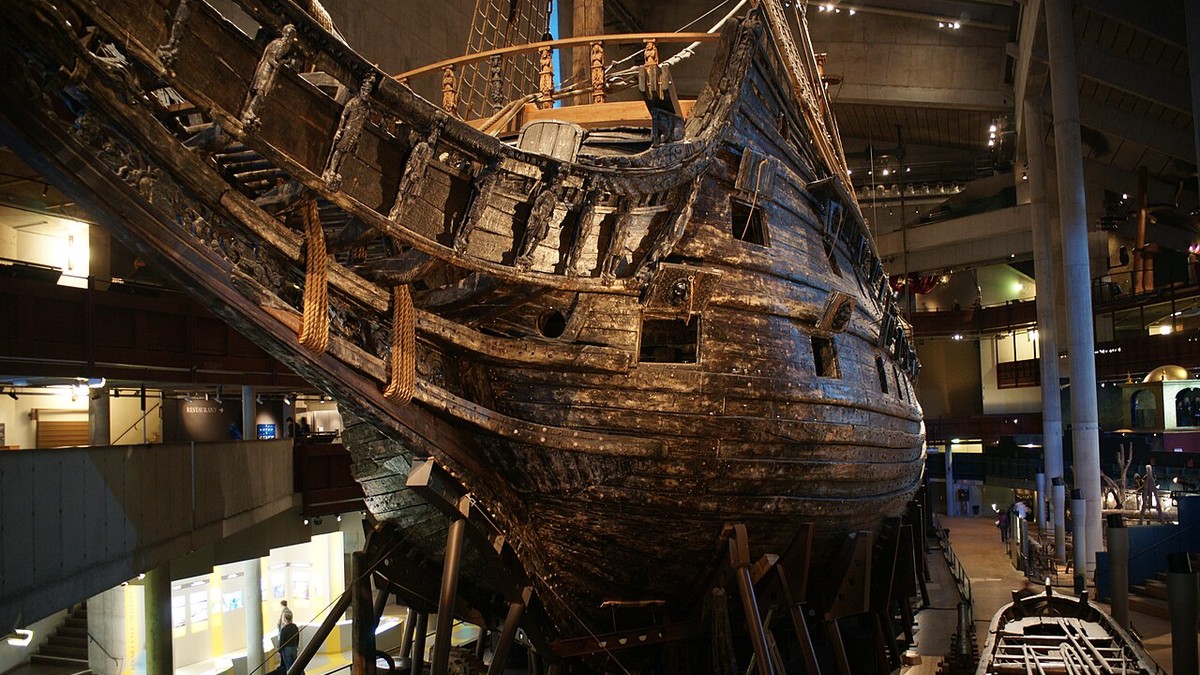
Built at the Royal Navy Yard in Stockholm (Skeppsgården) under master shipwright Henrik Hybertsson, the Vasa was designed as a prestige flagship, boasting 64 heavy cast-bronze cannons and adorned with over 500 elaborate, brightly painted allegorical sculptures depicting Roman emperors, Swedish lions, and biblical prophets. Her armament represented a terrifying leap forward in naval firepower, capable of delivering over 588 pounds of solid bronze shot from a single broadside.
Yet on Sunday, August 10, 1628, before thousands of celebrating Stockholm citizens, foreign diplomats, and royal officials, disaster struck. Minutes after casting off and hoisting four sails into a gentle Baltic breeze of barely four knots, a sudden minor squall pushed the towering warship onto her port side. Water flooded through her open lower gunports, and within twenty minutes, the pride of the Swedish fleet plummeted to the seabed, settling upright into thirty-two meters of thick harbor clay, barely a nautical mile from where she had been launched.
1. Imperial Ambition and the Skeppsgården Construction
The construction of Vasa occurred under immense geopolitical pressure. Gustavus Adolphus was personally intervening in the design specifications, demanding changes in overall length, keel proportions, and artillery layout while fighting campaigns in Poland. Master shipwright Henrik Hybertsson, a native of the Netherlands, was tasked with combining traditional Dutch flat-bottomed hull geometry with the immense vertical clearance required for two enclosed gun decks.
Over 1,000 prime Swedish oak trees, felled from royal crown estates in Södermanland and Småland, were used to fashion her keel, frames, and planking. Following Dutch shipbuilding traditions, Hybertsson worked without formal architectural blueprints or mathematical calculations of hydrostatics, relying instead on traditional proportional sticks and eye-of-the-shipwright methods. When Hybertsson fell terminally ill in 1627, direction of the shipyard passed to his assistant, Hein Jacobsson, who was left to execute an increasingly compromised design.
The Deadly Modifications to Artillery Allocation
The root of Vasa’s structural failure lay in the escalating demands for upper-deck artillery. Originally designed to carry a lighter battery, the ship was retrofitted to house forty-eight massive 24-pounder bronze cannons, cast specifically for the vessel at the royal gun foundry in Stockholm under the supervision of Swiss founder Medardus Gessus. Each of these 24-pounder guns weighed over 1.5 tons, totaling over 70 tons of concentrated metal weight distributed across two high decks.
To support this unprecedented ordnance, shipwrights thickened the upper deck framing and raised the height of the ornate carved aft castle to nearly 65 feet above the water surface. Crucially, the ship’s internal underwater hull cavity had not been expanded proportionately to receive the additional stone ballast necessary to counterbalance this immense top-tier mass.
| Architectural Metric | Vasa Specification | Engineering Deficit / Vulnerability |
|---|---|---|
| Overall Length (with Bowsprit) | 69 meters (226 feet) | Extended forward overhangs increased windage |
| Maximum Beam | 11.7 meters (38.4 feet) | Insufficient beam width to achieve stable Metacenter (GM) |
| Displacement | 1,210 Metric Tons | High center of gravity relative to hull displacement volume |
| Artillery Complement | 64 Bronze Guns (48 × 24-pdrs) | Massive top-deck weight overloading high carlings |
| Internal Ballast Capacity | Approx. 120 tons of stone | Restricted by narrow hull bilge; inadequate righting moment |
| Lower Gunport Sill Clearance | Barely 1.1 meters (3.6 feet) | Direct flood point under minimal 10-degree list |
2. Hydrodynamic Failure: The Physics of Negative Stability
The physical laws governing ship stability were not mathematically formulated until the eighteenth-century treatises of French mathematician Pierre Bouguer and Swiss scientist Leonhard Euler, who introduced the concepts of the Metacenter (M) and Metacentric Height (GM). In naval architecture, a ship’s stability depends entirely on the spatial relationship between its Center of Gravity (G)—the point through which downward gravitational weight acts—and its Center of Buoyancy (B)—the geometric center of the displaced water volume acting upward.
When a stable ship lists to one side under wind pressure, the underwater hull geometry shifts, moving the Center of Buoyancy outward and creating a positive righting lever arm (GZ) that automatically rights the vessel. In the case of the Vasa, the massive mass of forty-eight 24-pounder bronze guns mounted across two high enclosed decks, combined with the heavy oak upper works, elevated the ship’s Center of Gravity (G) to a critically high point. Simultaneously, her narrow underwater beam and limited stone ballast capacity restricted her righting lever arm to virtually zero.
The Ignored Stability Test of Captain Söfring Hansson
The fatal instability of the Vasa was not a total surprise to the shipyard. Weeks before her scheduled launch, the master of the ship, Captain Söfring Hansson, conducted an empirical stability test in the presence of Vice-Admiral Klas Fleming at the Skeppsgården dock. Thirty sailors were ordered to run back and forth across the upper deck from port to starboard.
On their first crossing, the warship listed heavily to port. On their second crossing, she heeled dangerously to starboard, and on the third run, the ship rolled so violently that water came close to the lower gunports. Terrified that the vessel would overturn immediately alongside the wharf, Admiral Fleming halted the test, declaring: ‘If only the King were at home!’ However, with Gustavus Adolphus sending urgent letters from the battlefield demanding the immediate dispatch of Vasa, no official dared delay her deployment or order the removal of guns to lower her center of gravity.
⚓ Hydrostatic Equation: Metacentric Height (GM)
GM = KM – KG. For a sailing warship to possess adequate initial stability, GM must remain positive and sufficiently large. In Vasa, KG (height of center of gravity) was so elevated that GM was barely a few inches. The moment lateral wind force heeled the ship past 10 degrees, the righting arm vanished completely, inducing irreversible capsize.
3. The Brackish Baltic Time Capsule and the 1961 Salvage
The salvage of Vasa represents the defining milestone in the birth of modern maritime archaeology. Following her sinking, early seventeenth-century divers using primitive diving bells under the direction of Hans Albrecht von Treileben accomplished the extraordinary feat of recovering over 50 bronze cannons in 1664, working in total darkness at depths of 100 feet. Thereafter, the location of the wreck faded into historical obscurity.
In the early 1950s, amateur maritime historian Anders Franzén realized that the unique environmental conditions of the Baltic Sea offered an unprecedented opportunity for underwater preservation. The Baltic Sea is an enclosed, brackish marine body with exceptionally low salinity levels (around 0.6% to 0.8%). The voracious shipworm (Teredo navalis), which consumes waterlogged timber throughout the Atlantic and Mediterranean within decades, cannot survive in water with salinity below 0.8%.
Anders Franzén and the Recovery Operation
Franzén systematically dragged the waters of Stockholm harbor using a custom-designed core sampler. On August 25, 1956, his core cylinder pulled up a plug of solid, blackened oak. Divers confirmed that the ship stood virtually intact on the seabed, surrounded by her fallen masts and ornate transom carvings.
The salvage operation, executed jointly by the Royal Swedish Navy and the private salvage firm Neptunbolaget, utilized a non-destructive tunneling technique. Navy divers operating high-pressure water monitors (Zetterström nozzles) washed out six tunnels directly beneath the ship’s keel. Wire cables were passed through these tunnels and connected to two massive pontoon lifting hulks, Sleipner and Frigg. In a series of 18 successive lifts between 1959 and 1961, the Vasa was moved incrementally into shallower water. On April 24, 1961, after 333 years beneath the sea, her upper oak frames broke the surface of Stockholm harbor, intact and structurally complete.
4. Chemical Preservation: The PEG Regimen and Acidity Battles
Upon breaking the water surface, the Vasa faced immediate chemical destruction. Over 300 years of submersion had caused bacteria to digest the cellular cellulose within the oak, leaving only the lignin skeleton saturated with water. Exposure to open air and natural evaporation would trigger rapid cellular collapse, warping, and shrinkage of up to 50% across the timber beams.
The Vasa conservation team pioneered the use of Polyethylene Glycol (PEG), spraying the entire 1,200-ton hull continuously for seventeen years (1962–1979) inside a purpose-built climate chamber, followed by an additional nine years of slow, computerized drying. Over 40,000 distinct artifacts—from wooden bowls, sails, and clothes to complete chests belonging to crewmen—were systematically conserved using freeze-drying and vacuum PEG impregnation.
The Modern Chemical Crisis: Acid Formation in the Wood
In the early 2000s, conservators discovered a new, invisible threat eating away at the Vasa’s hull: the formation of sulfuric acid inside the oak timbers. Over three centuries, anaerobic sulfate-reducing bacteria in the polluted harbor mud had metabolized organic matter, depositing an estimated two tons of elemental sulfur deep within the wood cells. Upon exposure to atmospheric oxygen and relative humidity, this sulfur slowly oxidized into sulfuric acid, breaking down the remaining wood polymers and degrading the original oak.
To combat this, the modern Vasa Museum maintains a hyper-controlled microclimate, keeping relative humidity within an extremely tight band of 52% (±1.5%) and temperature at exactly 18.5°C. Ongoing scientific research conducted in collaboration with global metallurgical and polymer institutes focuses on neutralising acid compounds and engineering a state-of-the-art internal steel support exoskeleton to eliminate physical stresses across the ancient hull.
5. The Modern Vasa Museum: A Window into the Baroque World
Opened in 1990 on the island of Djurgården in Stockholm, the Vasa Museum (Vasamuseet) is Scandinavia’s most visited cultural institution, welcoming over 1.5 million visitors annually. Because the ship sank on an ordinary Sunday afternoon with all crew possessions, armaments, and provisions stowed for sea, the wreck functions as an unmatched, unedited time capsule of seventeenth-century European civilization.
Conserved alongside the majestic warship are the skeletal remains of over 15 crew members, whose facial structures have been forensically reconstructed. Visitors can examine the actual ship’s sails—the oldest surviving sailing canvas in the world—alongside copper navigational instruments, medical bone saws from the barber-surgeon’s cabin, and thousands of recovered silver and copper coins. Vasa stands today as both a tragic cautionary tale of overambitious naval engineering and the supreme triumph of modern archaeological conservation.
6. The Royal Commission of Inquiry: The Trial Without Culprits (1628)
Following the catastrophic foundering of Vasa on August 10, 1628, the Swedish Privy Council (Riksrådet) convened an emergency Court of Inquiry at the Royal Palace in Stockholm on September 5, presided over by Lord High Admiral Carl Carlsson Gyllenhielm. With King Gustavus Adolphus demanding severe punishment for whoever was responsible for the loss of his flagship, the tribunal aggressively interrogated the surviving officers and shipwrights.
Captain Söfring Hansson testified under oath that the ship had been perfectly ballasted according to her internal volumetric capacity, and that the gunners had secured the upper cannons. When asked why he sailed with the lower gunports open, Hansson replied that the weather was calm and that he was ordered to fire a salute upon departing the harbor. The master shipwright, Hein Jacobsson, and the builder’s brother, Arent Hybertsson, testified that the ship had been built in strict accordance with the dimensions drawn and personally approved by King Gustavus Adolphus himself. Confronted with the unassailable reality that the ultimate author of the design was their sovereign monarch, the Council quietly dismissed all charges, concluding that ‘only God knows why the ship foundered.’
| Inquiry Witness | Official Naval Role | Key Testimony Submitted to Council | Investigative Finding |
|---|---|---|---|
| Captain Söfring Hansson | Commander of Vasa | Reported ship had zero righting moment; warned Admiral Fleming during stability test | Exonerated of negligence |
| Lieutenant Petter Gierdsson | Naval Gunnery Officer | Confirmed all 24-pounder bronze guns were lashed tightly to ringbolts | Cleared of shifting cargo blame |
| Hein Jacobsson | Master Shipwright (Post-Hybertsson) | Proved keel and beam dimensions followed King’s handwritten royal decree | No structural deviation found |
| Jöran Matsson | Chief Naval Storekeeper | Testified that 120 tons of granite ballast stones completely filled the lower bilge | Proved hull cavity could take no more stone |
Microbiological Remediation in 21st-Century Conservation
In addition to sulfuric acid neutralization, modern conservators at the Vasa Museum are combating iron-catalyzed oxidation. Over 5,000 original iron bolts that rusted away while submerged left heavy deposits of reactive iron ions throughout the oak. Scientists have replaced these corroded fasteners with custom-engineered non-reactive carbon-fiber and titanium suspension rods, ensuring that the 400-year-old warship remains structurally sound for future centuries.