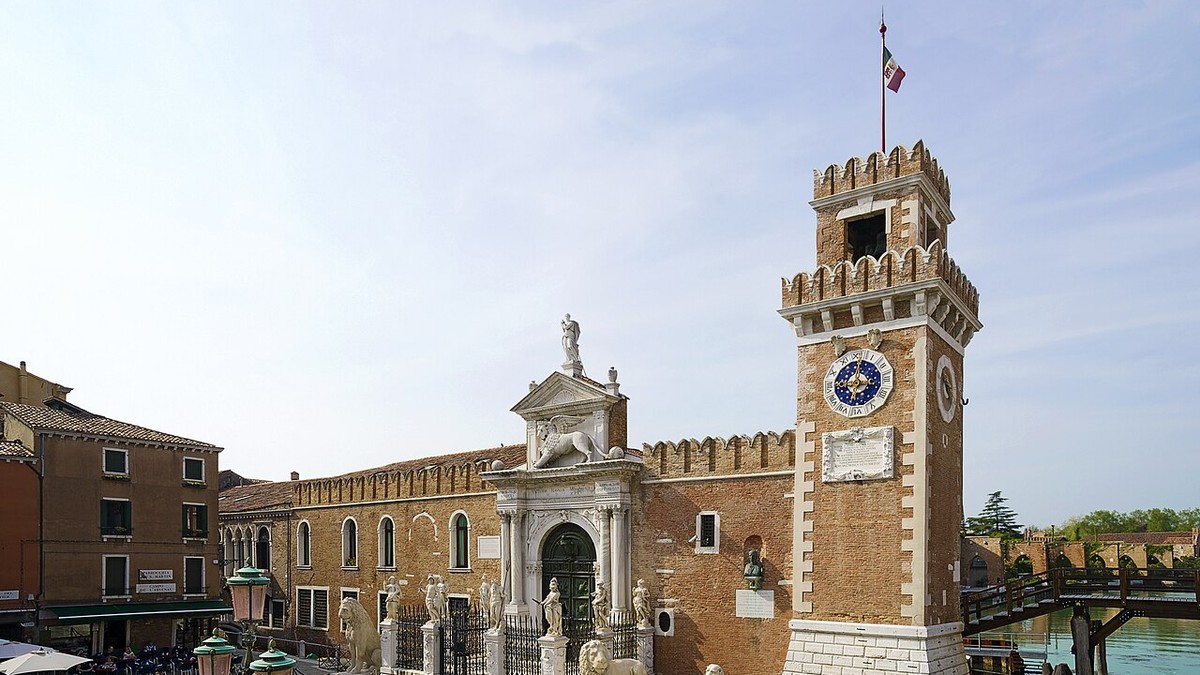
⚓ Monograph Overview: The World’s First Industrial Factory Complex
Centuries before the British Industrial Revolution, the Republic of Venice operated the largest industrial complex in pre-modern Europe: the Arsenale di Venezia. Spanning over 110 acres of enclosed ship basins, rope factories, and armories, the Arsenale employed over 16,000 skilled shipwrights and carpenters (Arsenalotti). Utilizing moving-line assembly methods and standardized interchangeable components, Venice could assemble, rig, and arm a fully combat-ready war galley in a single day.
For more than half a millennium, the maritime fortune, territorial dominion, and survival of the Republic of Venice (La Serenissima) rested upon a secluded, fortress-like enclosure situated in the eastern district of Castello: the Arsenale di Venezia. Derived from the Arabic word Dar al-Sina’a (‘House of Industry’), the Arsenale was founded in 1104 under Doge Ordelafo Faliero. Over the subsequent four centuries, it expanded from a modest municipal dockyard into an awe-inspiring, vertically integrated military-industrial empire covering over 15% of the total land surface of Venice.
The Venetian Arsenale was fundamentally unique in human history. In an era when European production was characterized by isolated guild workshops, bespoke craftsmanship, and erratic output, the Arsenale pioneered the principles of modern industrial manufacturing: assembly-line processing, strict component standardization, interchangeable parts, specialized division of labor, state-controlled strategic stockpiles, and just-in-time logistics. It was this extraordinary manufacturing engine that enabled Venice to maintain undisputed maritime hegemony across the Adriatic, the Aegean, and the Levant, dominating the lucrative Eurasian spice and silk trade routes.
The zenith of Venetian naval technology occurred during the titanic maritime clash of the Battle of Lepanto on October 7, 1571. Facing the seemingly invincible armada of the Ottoman Empire, the Holy League deployed six colossal, newly engineered Venetian galeasses—floating artillery fortresses developed directly within the Arsenale. The overwhelming firepower of these vessels shattered the Ottoman battle line, halting Ottoman naval expansion in the western Mediterranean and proving the technological superiority of Venetian naval architecture.
1. Industrial Assembly-Line Production Centuries Ahead of Its Time
The central triumph of the Arsenale was its revolutionary moving-line manufacturing methodology. When Dante Alighieri visited the Arsenale in the early fourteenth century, he was so astonished by the infernal heat, boiling pitch, and kinetic energy of thousands of workers that he immortalized the scene in the Inferno of his Divine Comedy (Canto XXI).
Unlike traditional shipyards where a single team of shipwrights built a vessel from the keel up in one static location, the Arsenale utilized a flowing canal-based assembly line. Partially assembled galley hulls were floated along a narrow interior canal flanked by specialized multistory workshops. At each stage along the waterway, specialized teams of craftsmen (Arsenalotti) added standardized sub-assemblies:
- Framing & Planking: Hulls were framed and planked using standardized oak molds in covered dry docks (volti).
- Caulking & Pitching: As the hull floated past the caulking docks, specialists hammered oakum soaked in boiling Venetian pitch into the seams.
- Masting & Rigging: The vessel reached the mast ponds, where pre-measured pine masts, lateen yards, and stays were hoisted into place.
- Ordnance & Armory: Bronze bow cannons (cannoni da corsia) cast in the Arsenale foundry were lowered onto centerline carriages.
- Victualing & Provisioning: Hardtack biscuits from the Arsenale bakery, casks of wine, and salted meat were stowed into the hold.
The Legend of the One-Day Galley (1574)
The speed of this assembly-line system was legendary across Europe. In 1574, when King Henry III of France visited Venice on his journey from Poland to claim the French throne, the Venetian Senate treated the monarch to an astonishing demonstration of industrial power.
When the King sat down to a banquet at the Doge’s Palace, the bare, prefabricated timbers of a war galley were positioned at the entrance of the Arsenale canal. Over the course of the two-hour banquet, the ship moved along the assembly line. By the time Henry III rose from the table, a fully rigged, armed, and manned 24-bank light galley (galea sottile) was launched into the lagoon and discharged a celebratory artillery broadside before the stunned monarch.
| Production Stage | Specialized Guild / Workshop | Interchangeable Standardized Component | Industrial Efficiency |
|---|---|---|---|
| Hull Framing | Maestri d’Ascia (Ship carpenters) | Standardized oak futtocks and frame templates | Over 100 galley frames held in dry storage |
| Caulking & Sealing | Calafati (Caulkers) | Standardized oakum rope & Venetian pitch | Watertight sealing completed in under 4 hours |
| Rope & Cordage | Corderie della Tana (Rope makers) | Standardized hemp rigging, halyards, and cables | Continuous 316-meter ropewalk facility |
| Oar Manufacture | Remeri (Oar makers) | Pre-balanced 10-meter beechwood oars | Interchangeable balance across all rowing benches |
| Artillery Founding | Fonderia delle Artiglierie | Standardized cast-bronze naval culverins | Interchangeable carriage mounts and iron shot caliber |
2. The Corderie della Tana: The Empire’s Nerve Center of Cordage
A sailing or rowing warship is only as reliable as its cordage. Standing at the southern edge of the Arsenale complex was one of the longest industrial brick buildings in the pre-industrial world: the Corderie della Tana, measuring an incredible 316 meters (1,036 feet) in continuous length and 21 meters in width.
Within this vast covered corridor, hundreds of workers manufactured all the rigging, anchor cables, stays, and sails for the Venetian fleet. The Arsenale maintained a total state monopoly over high-grade hemp (canapa), imported exclusively from the fertile soils around Bologna and the mouth of the Po River. The ropewalk utilized massive mechanical spinning wheels and stretching tracks, producing four-strand tarred hemp cables over twenty inches in circumference, capable of securing multi-ton merchant galleasses during savage Aegean squalls.
Strategic Silviculture: The Sacred Oak Forests
The Arsenale’s industrial capacity required staggering volumes of timber. To prevent resource exhaustion, the Council of Ten established one of the world’s earliest state-mandated forestry preservation systems. Specific old-growth forests on the mainland—most notably the Forest of Montello near Treviso and the woods of Istria—were declared sovereign reserves belonging exclusively to the Arsenale.
Every oak tree suitable for ship ribs was cataloged, numbered, and protected under pain of execution or galley enslavement. Foresters trained young oak saplings to grow with specific curves by tying their branches, producing naturally curved ‘compass timbers’ that matched the exact curvature of galley futtocks and knees, ensuring maximum grain strength without weak joints.
3. Technological Zenith: The Galeass of Lepanto (1571)
Throughout the medieval era, Mediterranean naval warfare was dominated by the light galley (galea sottile). Slender, low-freeboard, and maneuverable under oars, galleys relied on ramming, forward-firing bow cannons, and boarding melee. However, galleys could not carry heavy broadside artillery because the presence of rowing benches along the entire length of the hull prevented gunports from being cut into the sides.
In response to the growing Ottoman threat, Venetian naval architects in the mid-sixteenth century conceived a revolutionary hybrid: the Galeass (galeazza). Developed from the heavy merchant galley (galea grossa), the galeass was significantly larger, wider, and possessed a much higher freeboard than standard galleys. It combined three towering masts carrying massive lateen sails with twenty-five rowing benches per side, with each giant oar manned by seven or eight rowers.
The Round-Battery Artillery Fortress
Crucially, the galeass featured a raised, circular wooden forecastle known as the ’round battery’, packed with heavy bronze cannons, culverins, and carronades. Beneath the rowers, and along the upper gunwales, engineers mounted an array of broadside swivel guns and breech-loaders, transforming the vessel into the world’s first successful broadside artillery warship. A single galeass carried over 40 to 50 heavy guns—more than five times the firepower of any standard galley.
At the Battle of Lepanto in 1571, six Venetian galeasses commanded by Francesco Duodo were towed half a mile ahead of the Holy League battle line. As the vast crescent of Ottoman galleys advanced, the galeasses opened fire with devastating rolling broadsides. Their heavy shot smashed Ottoman galleys to splinters, dismounting enemy oars and creating utter chaos, allowing the Christian fleet to achieve a decisive, historic victory.
⚓ Tactical Assessment: The Impact of the Galeass at Lepanto
Ottoman chroniclers described the six Venetian galeasses as ‘floating islands of fire’. Unable to board the towering wooden hulls or penetrate their thick oak bulwarks with composite bow arrows, the Ottoman galleys broke formation, losing over 200 warships in the engagement. The battle proved that artillery-centric naval architecture had permanently superseded traditional ramming and boarding tactics.
4. The Arsenalotti: The Elite Guild of the Republic
The workforce of the Arsenale—the Arsenalotti—formed a unique, highly privileged hereditary socio-economic class in Venice. Numbering between 10,000 and 16,000 men at its peak, the Arsenalotti were fiercely loyal to the Republic. Unlike ordinary urban laborers, they enjoyed guaranteed lifetime employment, free state medical care, state pensions, subsidized housing, and daily allotments of pure wine and biscuits.
The Doge of Venice regarded the Arsenalotti as the supreme guardians of the state. During elections of a new Doge, an elite guard of Arsenalotti physically carried the newly elected prince around St. Mark’s Square on their shoulders. When the Doge died, Arsenalotti held the keys to the state treasury and manned the defenses of the Doge’s Palace, protecting the city against civil unrest or foreign plots.
5. Decline, Napoleonic Destruction, and the Modern Heritage
The decline of the Venetian Arsenale mirrored the strategic marginalization of the Mediterranean Sea. The discovery of oceanic trade routes around the Cape of Good Hope by Vasco da Gama in 1498 and the rise of transatlantic commerce shifted global economic wealth toward Atlantic seafaring nations—Spain, Portugal, England, and the Netherlands. The low-freeboard Mediterranean galley, unable to withstand the colossal swells of the Atlantic, was rendered obsolete by the full-rigged, ocean-going galleon and ship of the line.
When Napoleon Bonaparte captured Venice in 1797, ending eleven centuries of uninterrupted republican independence, French troops systematically looted the Arsenale, burning its historic Bucintoro (the Doge’s golden ceremonial galley) to extract its gold leaf, melting down ancient bronze cannons, and destroying the dry docks to prevent the Austrian Empire from inheriting Venetian naval power.
Today, the Arsenale di Venezia stands as one of the world’s most magnificent industrial heritage monuments. Serving in part as an operational base for the Italian Navy and hosting the prestigious Venice International Art and Architecture Biennale, its monumental Porta Magna (the grand gateway constructed in 1460, guarded by ancient Greek marble lions) endures as a symbol of the brilliant era when Venetian engineers transformed manufacturing into an art, commanding the maritime destiny of Europe.
6. Strategic Arms Manufacture: The Bronze Foundries of the Arsenale
In addition to naval hull assembly, the Arsenale was the supreme center of metallurgical armament production in the Mediterranean. Within the Fonderia delle Artiglierie, master bell- and gun-founders operated multi-chamber reverberatory furnaces capable of melting over ten tons of copper-tin alloy simultaneously. Under the direction of celebrated foundry families like the Alberghetti, Venice standardized naval artillery calibers a full century before European nations adopted uniform ordnance establishments.
Every war galley launched from the Arsenale was armed with a standardized centerline battery: one colossal 50-pounder bronze cannone da corsia mounted on the keel axis between the rowing benches, flanked by two 12-pounder aspici and two 6-pounder falconetti. Because every gun carriage, trunnion bracket, and iron shot mold was manufactured to rigorous state tolerances, ammunition was 100% interchangeable across any warship in the Venetian fleet, eliminating supply confusion during the chaos of naval combat.
| Artillery Designation | Caliber & Shot Weight | Gun Barrel Weight | Mounting Location on Galley | Tactical Role in Combat |
|---|---|---|---|---|
| Cannone da Corsia | 50 lbs solid cast-iron/bronze | Approx. 5,000 lbs (2,300 kg) | Centerline bow keel between rowers | Main tactical battering ram; penetrates enemy flagship hulls |
| Aspide / Sagro | 12 lbs solid round-shot | Approx. 2,200 lbs (1,000 kg) | Port & starboard bow battery | Counter-battery fire against approaching enemy rowers |
| Falconetto | 6 lbs solid shot / canister | Approx. 1,000 lbs (450 kg) | Bow flanking swivel mounts | Anti-boarding deck clearance & mast destruction |
| Petriere a Braga | Stone shot (14 to 20 lbs) | Wrought-iron breech-loader | Broadside gunwale swivels | Close-quarters antipersonnel barrage prior to boarding |
7. Venice’s Strategic Maritime Supply Chain and Timber Logistics
The industrial output of the Venetian Arsenale was sustained by an intricate, highly organized continental logistics network. To ensure an uninterrupted supply of raw materials, the Venetian Republic established specialized administrative magistracies, most notably the Provveditori all’Armar and the Patroni all’Arsenale, who governed the import of copper from German mines, iron from Brescia, and sail canvas from Lombard flax fields.
Every individual tree felled in the state forests of Istria and Montello was marked with the winged Lion of Saint Mark and transported via river rafts down the Brenta and Piave rivers directly into the sheltered waters of the Venetian lagoon. This state-controlled resource security enabled Venice to rapidly replace fleet losses following major naval engagements, sustaining its maritime empire across five centuries of Mediterranean warfare.