⚓ Monograph Overview: The Capital of World Maritime Trade
Between 1700 and 1850, the Port of London was the unrivaled economic heart of the global British Empire. Stretched along the tidal River Thames from London Bridge down to Greenwich, the ‘Pool of London’ handled thousands of merchant sailing ships laden with Caribbean sugar, East Indian spices, Virginian tobacco, and Baltic timber. To overcome rampant river piracy, tidal grounding, and catastrophic gridlock, Victorian civil engineers built the monumental enclosed wet docks that revolutionized global port infrastructure.
During the eighteenth and nineteenth centuries, the River Thames flowed not merely through the heart of the British capital, but through the central economic circulatory system of the world. Great Britain’s ascendance to global imperial dominance, fueled by the Royal Navy’s command of the oceans and the rapid expansion of the East India Company, funneled unimaginable wealth into the Port of London. From the East Indies, China, the Caribbean, the Americas, Africa, and the Baltic, heavily laden sailing vessels navigated the winding reaches of the Thames to discharge their precious global cargoes.
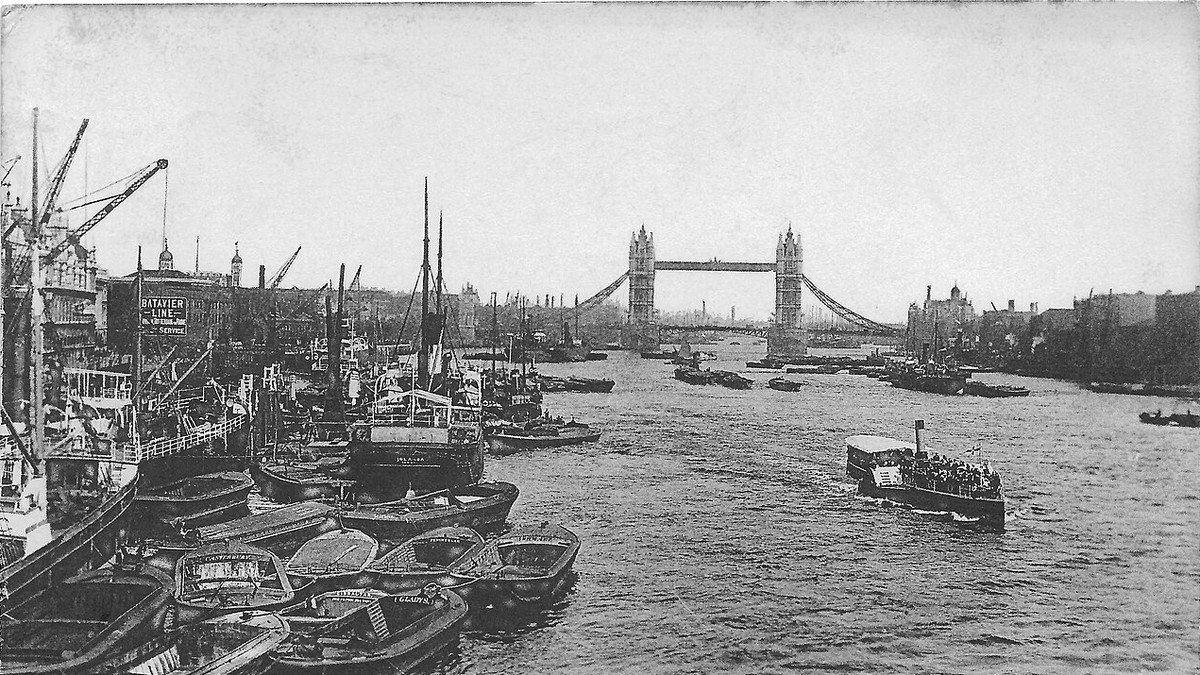
However, the geographical and infrastructural capacity of eighteenth-century London was woefully inadequate to receive this tidal wave of global commerce. Centered upon the Pool of London—the tidal stretch of the Thames immediately below the stone arches of medieval London Bridge—the port suffered from suffocating river gridlock, rampant smuggling and organized theft, and severe tidal hazards. Ships were forced to anchor six or eight abreast in the open river, waiting weeks for a berth along the antiquated Elizabethan quays, while their cargoes were plundered by thousands of river pirates.
The salvation of London’s maritime economy was accomplished through one of the most audacious civil engineering transformations in human history: the excavation of the enclosed wet dock systems. Engineered by legendary civil engineers such as William Jessop, John Rennie, and Thomas Telford, vast deepwater artificial basins equipped with hydraulic lock gates were carved out of the marshlands of Wapping, the Isle of Dogs, and Rotherhithe. These enclosed docks transformed London into an impenetrable, automated fortress of global logistics that defined the Victorian Age.
1. The Pool of London: Gridlock, Lighterage, and River Piracy
By the 1790s, the Port of London had reached a point of complete structural collapse. Between 1700 and 1795, the value of imports and exports passing through London exploded by more than 300%, and the annual arrival of merchant ships exceeded 13,000 vessels. Yet the physical riverfront designated for customs clearance—the ancient Legal Quays, established under Queen Elizabeth I in 1558—measured a pathetic 1,419 feet (432 meters) in total length, situated between the Tower of London and London Bridge.
Because deep-draft East Indiamen and West Indian sugar ships could not come alongside these cramped wharves, the port operated entirely through the archaic lighterage system. Ships anchored out in the tidal stream of the Pool of London, and their cargo was transferred by hand into thousands of open, unpowered wooden barges known as ‘lighters’. These lighters were then rowed or poled through the congested river traffic to the Legal Quays, where cargo sat exposed on open pavements for weeks awaiting customs weighers.
The Plunder of the River: Scuffle-Hunters and Night Plunderers
This disorganized system fostered an unprecedented epidemic of maritime crime. An estimated 10,000 people along the Thames survived entirely through cargo theft, organized into specialized criminal guilds described by magistrate Patrick Colquhoun in his pioneering 1800 study A Treatise on the Commerce and Police of the River Thames:
- Night Plunderers: Watermen who rowed out to moored ships under cover of darkness, cutting anchor cables, boarding through open ports, and hauling away complete casks of sugar and rum.
- Heavy Horsemen & Light Horsemen: Corrupt dock workers and mates who wore specially tailored baggy coats lined with hidden bladders capable of smuggling twenty pounds of West Indian sugar, coffee, or rum off the quays daily.
- Scuffle-Hunters: Gangs of casual river laborers who hovered around the wharves, intentionally puncturing sugar hogsheads with iron spikes and scooping up the spilled sugar into pouches.
- Mudlarks: Impoverished women and children who scavenged through the low-tide river mud beneath the lighters, retrieving dropped raw materials, iron nails, rope pieces, and tobacco canisters.
Colquhoun calculated that annual cargo theft on the Thames exceeded £500,000 (hundreds of millions of pounds today), threatening British merchants with systemic bankruptcy and prompting the creation of the Marine Police Force in 1798—the oldest continuous police force in the world.
| Enclosed Dock System | Year Opened | Chief Civil Engineer | Water Acreage & Depth | Primary Colonial Commodities |
|---|---|---|---|---|
| West India Docks | 1802 | William Jessop & John Rennie | 54 Acres; 24-foot depth | Caribbean sugar hogsheads, rum puncheons, mahogany |
| London Docks (Wapping) | 1805 | John Rennie | 30 Acres; multi-vault cellars | Fortified wines (Port, Sherry), brandy, wool, tobacco |
| East India Docks | 1806 | Ralph Walker & John Rennie | 30 Acres; 24-foot depth | Indian textiles, spices, Chinese porcelain, Bohea tea |
| St Katharine Docks | 1828 | Thomas Telford & Philip Hardwick | 10 Acres; steam crane wharves | High-value luxury goods: ivory, silk, spices, marble |
| Surrey Commercial Docks | 1807–1864 | Various Victorian engineers | Over 400 Acres (Rotherhithe) | Softwood timber deals from Canada and the Baltic |
2. The Wet Dock Engineering Revolution: William Jessop and the West India Docks
The definitive breakthrough came in 1799, when Parliament passed the West India Dock Act, authorizing a syndicate of wealthy merchants to construct an enclosed, secure wet dock complex across the northern neck of the Isle of Dogs. Engineered by the preeminent hydraulic civil engineer William Jessop, with architectural designs by John Rennie, the West India Docks (opened in 1802) revolutionized port engineering.
The fundamental hydraulic challenge of the Thames was its immense vertical tidal range of over twenty feet (six meters). At low tide, ships anchored in the river grounded in the mud, imposing severe hogging and structural twisting on wooden hulls. Jessop solved this by excavating two parallel artificial basins—the Import Dock (30 acres) and the Export Dock (24 acres)—enclosed by massive stone entrance locks fitted with cast-iron hydraulic sluices.
The Hydraulic Lock Gate System
Merchant ships entered the outer tidal basin from the Thames at high water. The outer lock gates were sealed, and ships passed through the inner locks into the wet docks, where the water level was maintained at a permanent, constant high-water depth of 24 feet, regardless of the fluctuating tide outside in the river. For the first time in London’s history, heavy ocean-going sailing ships could remain permanently afloat, berthed directly alongside continuous brick-paved quays.
To eliminate river piracy, Jessop transformed the West India Docks into an impenetrable fortress. The entire 54-acre complex was surrounded by a thirty-foot-high brick wall, encircled by an external military ditch, and guarded 24 hours a day by armed sentries. Ships were unloaded directly into colossal five-story brick warehouses designed with iron fire-doors and massive subterranean wine vaults. Smuggling and cargo theft were reduced to zero overnight.
3. John Rennie and the Great Wine Vaults of Wapping
Following the triumph of the West India Docks, Scottish engineer John Rennie directed the excavation of the London Docks in Wapping (1805), situated barely a mile from the City of London. Designed specifically to handle Continental European wine, brandy, rice, and tobacco, Rennie’s masterpiece was the extraordinary subterranean infrastructure excavated beneath the dock quays.
Covering more than twenty acres beneath ground level, Rennie constructed the legendary Crescent Wine Vaults. Supported by thousands of slender granite columns and curving brick groin-vaults, these temperature-controlled underground catacombs maintained a permanent, natural temperature of 55°F (13°C) and constant humidity. In these subterranean galleries, over 100,000 massive wooden casks of vintage port, Madeira, sherry, and French cognac matured in total darkness, illuminated only by oil lanterns held by coopers checking for leaks.
The Tobacco Dock and Queen’s Pipe
Adjacent to the wine vaults stood the massive Tobacco Dock, covering five acres of open warehouse space under an astonishing open timber truss roof designed by Rennie. Within this warehouse, tens of thousands of hogsheads of Virginian and Carolinian tobacco were stored under customs bond.
To dispose of damaged, moldy, or uncustomed tobacco that merchants refused to pay duties upon, customs authorities erected a giant conical brick kiln inside the warehouse known as ‘The Queen’s Pipe’ (or the King’s Pipe). Here, tons of confiscated tobacco and tea were burned continuously, sending a thick, fragrant aromatic smoke billowing across the rooftops of East London for days at a time.
⚓ Engineering Highlight: Thomas Telford’s St Katharine Docks (1828)
Built by master engineer Thomas Telford in 1828 immediately east of the Tower of London, St Katharine Docks demonstrated the extreme optimization of urban space. Telford designed the warehouses directly on the water’s edge, supported by massive hollow cast-iron Doric columns, allowing hydraulic cranes to hoist cargo directly from ship holds into upper warehouse floors in a single continuous lift.
4. The Timber Trade of Surrey Commercial Docks
While the north bank of the Thames handled valuable spices, sugar, rum, and wine, the south bank at Rotherhithe evolved into the global center for the bulk timber trade: the Surrey Commercial Docks. Industrializing Britain consumed unfathomable quantities of timber—pine baulks, teak beams, and sawn softwood deals imported from the Russian Baltic, Scandinavia, and Canada to build Victorian railway sleepers, mine pit-props, urban housing rafters, and ship timbers.
Because structural timber could not be allowed to dry out too quickly without checking and cracking, the Surrey Docks consisted of dozens of interconnected shallow timber ponds covering over 400 acres. Here, hundreds of thousands of giant logs floated in fresh water, sorted by species and grade by a specialized class of timber dockers known as ‘deal porters’, who became famous for running across floating logs balancing 100-pound planks on their leather-helmeted heads.
5. From Sail to Steam: The 20th-Century Legacy and Docklands Rebirth
Throughout the nineteenth century and the first half of the twentieth century, the enclosed docks of London expanded further downriver to accommodate colossal iron steamships—culminating in the construction of the Royal Victoria, Royal Albert, and King George V Docks (the Royal Docks), which formed the largest enclosed body of dock water in the world.
However, the global containerization revolution of the late 1960s brought an abrupt, devastating end to the historic Port of London. Giant cellular container ships could not navigate the shallow, winding urban Thames; shipping shifted to deepwater coastal container ports at Tilbury, Felixstowe, and Southampton. Between 1968 and 1981, every single one of London’s historic upstream docks was permanently closed, throwing tens of thousands of dockworkers out of work and leaving East London a vast derelict wasteland.
In the 1980s and 1990s, the historic wet docks underwent the largest urban regeneration project in Europe under the London Docklands Development Corporation (LDDC). The Isle of Dogs was transformed into the glittering financial skyscrapers of Canary Wharf, while the great brick warehouses of Wapping and St Katharine Docks were conserved as luxury residences, yacht marinas, and cultural centers. Today, the water of Jessop’s and Rennie’s great wet docks remains clean and calm—an immortal engineering reflection of the era when the Port of London was the maritime master of the world.
6. The Hydraulic Machinery Revolution: Lord Armstrong’s Cranes
The operational efficiency of the enclosed wet docks of London was multiplied exponentially during the mid-nineteenth century through the adoption of high-pressure hydraulic power, invented by English industrialist William George Armstrong. Prior to hydraulic mechanization, dock cranes, lock gates, and swing bridges were operated manually by hundreds of dock laborers turning iron hand-cranks, a slow and physically exhausting process.
In the 1850s, Armstrong installed centralized hydraulic pumping stations throughout the West India, London, and Victoria Docks. Powered by massive steam engines, water was pumped at colossal pressures of 700 to 800 psi into towering hydraulic accumulators—giant cast-iron cylinders weighted with hundreds of tons of iron slag. High-pressure water was distributed through miles of cast-iron pipes beneath the dock quays, powering hydraulic cranes that could hoist five-ton cargo crates out of ship holds in seconds, and swinging multi-hundred-ton lock gates open with the touch of a single control lever.
| Dock Mechanization System | Power Source | Mechanical Mechanism | Operational Throughput Impact |
|---|---|---|---|
| Manual Treadwheel Crane | Human labor (Convict / dockers) | Timber treadwheel with rope drum | Unloaded 10 to 15 tons of cargo per day |
| Armstrong Hydraulic Crane | High-pressure water (800 psi) | Hydraulic piston and multi-sheave chain | Unloaded over 150 to 200 tons of cargo per day |
| Hydraulic Lock Gate Ram | Central steam accumulator network | Direct-acting hydraulic cylinder ram | Lock cycling reduced from 45 minutes to 6 minutes |
| Hydraulic Swing Bridges | Water pressure counter-balance | Pivoting center hydraulic turntable | Permitted continuous road traffic across dock cuts |